Australian IPA review

A little while ago, Mikey made his first trial of the Australian IPA, lots of different hops, and then some.Aus IPA

It was a great beer, and pretty hoppy, but not quite as hoppy as one would expect given what was thrown in there…

The aroma was great, with sweet caramel and biscuit smells.  Some lychee was thrown in for good measure as well hints of vanilla.  I was expecting a little bit more in there given all the hops.  It’s possible that it was too much and things simply got confused.

All in all, it looks and feels light for an IPA.  It has a good body, but not as heavy as would be expected.  The hops don’t come creaming out, but the bitterness is there and sits at the back as you would expect.  There are some great citrus and sour notes in the taste.  However, it’s fairly mild for an IPA.

Adding to this, finding any malt in the flavour was difficult.  The biscuit and caramel was great in the smell, and some malt in the taste would have been great.  This is a very hop driven beer, yes, but it needs some malt to wrap around.  Alternatively, it could have been good just to push the hops further and leave it at that.  In my opinion, that’s the two general directions an IPA can go.

-Chas

All that being said, this was a good, easy drinking beer.  It could easily be a nice session beer.

Tagged , , , ,

Back to black, brewing Super Stout

Back from holidays. Back to brewing. Back to black.

Yep, Saturday was the first weekend back from a two week holiday overseas. It seamed like a perfect idea to get Chas over and brew again. Plus we were able to do another dark brew. Super Stout was the brew for the day, and is was very dark brew indeed.

Super Stout 1

Super Stout 1 in the fermenter waiting to be topped up with water

Last dark brew I did was the Baltic Porter #2. That was back in November, nearly six months ago. That’s running very low and will likely be all gone by the time the Super Stout is ready to drink. The weather is getting right for stouts and porters, it has already gotten pretty cold here in Melbourne. But that might have more to do with the temperature difference between the holiday overseas verse back home.

The brew day was a simple and easy one. Did a kit from Brewcraft / Liquorcraft / Australian Home Brewing… I’m always getting confused by their name. I’m just going to continue to refer to that company by their official company name, Australian Home Brewing Pty Ltd. Anyway, the kit was their Super Stout. Got this one as a gift for Christmas. Didn’t want to wait much longer before using the ingredients. Apparently liquid malt can go a bit funny if it’s been in a can too long. Yeast was fine as I kept in the fridge since December.

The kit comes with everything you need.

  • 1.7kg can of Black Rock Miners Stout
  • 1.5kg can of Black Rock Dark Liquid Malt Extract
  • 500g Corn Sugar
  • 10ml liquorice extract
  • Safale S-04 (whole 11g pack)

A fairly simple kit and very easy to make. The liquorice was unexpected. I’ve seen it as an ingredient in home brew shops before but wasn’t game to try myself. Given that it’s included in a lot of stout recipes I’m sure it’ll be fine. We’ll wait for the tasting review.

Process for this brew is very simple. Boil 2-3 litres of water. Heat off. Add both cans of liquid malt. Add corn sugar. Stir until dissolved. Add to fermentation vessel. Top up to 18 litres. Add licorice. Stir up really well. Gravity reading. Pitch yeast. Done.

The whole brew was all done in about an hour. Topping up the water was nearly the longest process. There was plenty of ice and ice cold water ready to chill. The delay was getting the rest of the water filtered. The water quality isn’t the best here due to the pipes. There is only one filtering jug and it takes time. Might need to prepare that better next time.

Gravity came in at 1.064. That’s pretty good. The instructions pack said final gravity would come in around 1.025 – 1.030. If that’s the case I’m looking at a beer that will be around 5.0% to 5.6% after bottling. That’s okay, but was hoping for something a bit higher for a stout. I drank some of the gravity sample and it tasted great. Dark and sweet, exactly what you’d expect.

There was some beer tastings as well. Cracked open a bottle of Chas’s basic pale ale. Also tried my Australian IPA. Both reviews should make their way up over the next week or so.

Overall it was a relaxed brew day. Nothing complex. Nothing boring. Nothing special. Two guys making a beer and taking it easy. Nice.

-Mikey

Tagged , , , , , ,

Australian Pale Ale 4 – review

Mikey continued his experiment with different hops with the Australian Pale Ale #4, and this one was pretty tasty.

The beer was a single hop using the Victoria’s Secret hop variety, a really good, relatively new variety.  The hop was used for aroma, taste, and bittering.

In the smell, there were some great subtle aromas: mild citrus and a bit of cut grass.  There was a bit of stone fruit in there too.  On the malt side, there was a bit of sweetness to the smell which tends to be a theme in the Mikey’s Australian Pale Ale series.  The whole point of the series is to keep the same malt and simply show off the hop after all.

In the taste, while it’s called the Australia Pale Ale, it’s closer to the American style, albeit with a very Aussie hop.  Vic Secret is a pretty bitter hop.  There’s a quick build and the bitterness kind of goes “whoosh” into your mouth and sits in the back.  Behind this, at the end, is a little bit of lemon zest as well which is a nice twist.

Other than that, it’s all pretty standard.  It’s a great beer made with a great, versatile hop.

Due to the bitterness, this may be a difficult beer to enjoy with a lots of foods.  It would go well with saltier snacks rather than a meal.  Pop corn or cheddar cheese (not too sharp) would work.

-Chas

Tagged , , , ,

Mikey’s Sneaky Cider

Way back in February, Mikey made a really quick cider called the Sneaky Cider, and I finally got around to tasting it!

Firstly, it had a great colour.  Nice and clear, with the colour of a basic sparkling apple juice – not surprising considering it was just sparkling apple juice (with some alcohol!).

Sneaky ciderThe first impression was that this was a very dry cider, but not overly so.  Strangely, the whole drink resembled a Chardonnay.  This isn’t a bad thing, as I’m quite fond of the grape.  I usually like a drier cider, and, to my taste, this could have been even drier, but I acknowledge this isn’t for everyone.  All in all it was quite well balanced and, at 7.9%, the alcohol was well hidden.

On the flavour, initially there wasn’t a lot of apple flavours, but the drink was certainly refreshing!  As the drink warmed up, however, the apple flavours start to come through.  The flavours start off quite laid back, then a bit of aroma comes through, and, before you know it, the apple becomes the dominant flavour.  While the name of this cider came from the fact that Mikey made it quite quickly, the flavour is just as sneaky.

I like that this cider was on the dry side.  Popular ciders today are often to sweet and they take away from the natural tang of the apples.  This cider still had tang without feeling like you were biting into an apple: it tasted like apple, but not too much so!  Basically, it was different from what the commercial ciders are doing.

I really liked this cider.  I’d do this with some pork chops!

-Chas

Tagged , , , , ,

Bottling before leaving, with a tasty beer

Sunday at my place was a very quick one. Only four litres of the Australian IPA #1 to be bottled. Plus sat down for a taste test of the Australian Pale #4. No brewing because in two weeks I’ll be on holidays. I don’t want to leave something in the fermenter too long. Will pick things up once I’m back.

Australian IPA 1

Australian IPA 1 in the carboy and ready for bottling

The bottling went very well with 13 stubbies sanitised, filled and capped super quick. The bulk priming works a treat. Getting the hang of tipping the priming vessel so you get the right angle to help liquid flow down the bottling wand.

Gravity came in at 1.015. At first I was a little disappointed, then realised I had dry hopped (see the photo with the hop bag). Plus the original gravity was 1.058 which means after bottle conditioning I’m looking at about 6.1% alcohol. That’s good for the style.

The sample we tried was very bitter. That’s somewhat expected for an IPA. I’m hoping the flavour and aroma comes out a bit more. I’ll sneak in a taste just before holidays, then we’ll do a proper tasting in about a month.

As I mentioned, we did a proper tasting of  Australian Pale Ale #4. Chas liked it and will write up a review soon-ish. Personally it’s my favourite pale ale I’ve made. And sits next to Baltic Porter #2 to battle it out as the best beer I’ve made. Not much left, might need to make some more once I’m back.

-Mikey

Tagged , , , , , ,

Back to Basics – Basic Pale Ale (take 1)

Oh the humble pale ale!

While it is in fact lager that is the most widely made and consumed beers, it’s probably the pale ale that has the most variants and allows itself the most experimentation – at least according to me.

Because of this, the pale ale is great place for experimentation and a great way to learn more about the craft of beer making.  While Mikey and I have done quite a few brews, of course we still have quite a bit to learn.  So it’s been decided to make the most basic of basic pale ales and work our way up from there.

Keep in mind, yes, Mikey has been been experimenting with “basic” pale ales.  His is an exercise in playing with different hops, seeing how they go as a single hop, and seeing how they interact.  This is an exercise in making a very basic recipe, and building on that very same recipe.

Yes, this is a basic one – just some traditional pale ale malt and some hops.  What hops to use was an educated guess.  We’ll see how it tastes and develop from there.

The Basic Pale Ale

The following is for a four litre batch.

  • 1 kg traditional ale malt

    20140329_130047

    Mashing some grains!

  • 4 grams Chinook (bittering – 60 minutes)
  • 4 grams Cascade (taste – 20 minutes)
  • 4 grams Citra (aroma – 2 minutes)
  • US05 Ale Yeast

The malt was mashed at 65 degrees in five litres of water for 90 minutes.  We felt this was a pretty good rule of thumb to start with.  As mentioned, this recipe will be the skeleton for what will be developed into a unique recipe.

After the initial mashing, we sparged with another 1.5 litres of water.

This left us with 6.5 litres at the start of the boil, noting that this is a recipe for 4 litres!  Unsurprisingly we lost a fair bit of water in the boil and ended up with about 3.5 litres when it was added to the carboy.

We were aiming for an American Pale Ale style of hopping.  According to our calculations, the IBUs came in on the top end of the style, which is fine, especially as there will be some other great fruity, tropical, and pine flavours coming through with the hops.

I’m really keen to see how this turns out. I’m sure there will be some more flavours that we’ll want to add in there, but we’ll let the first batch tell us what those are and go from there.

20140402_192724

Tucked up and ready to go

-Chas

Tagged , , , , ,

Malted Cider 2 – review

On Saturday Chas had another brew day at his place. Was another good day with what should be a good beer. He’ll cover the details later. We did some tastings on the day. My Sneaky Cider and Chas’s Malted Cider 2. Two different takes on cider.

Malted Cider 2

Malted Cider 2 ready for drinking

The Malted Cider, a graft, was the second attempt by Chas. The first one was an okay drink. But each time I tried some it was eggy in aroma. Chas said that there was less egg smell in the other bottles. Anyway, onto the new version. And it had a slight eggy smell. Granted it was very slight, and Chas assures me that there isn’t any of that in other bottles. The main character for the aroma was the rich sweetness. Not a sickly sweetness like raw sugar, more like rich fruit.

After the smell the first thing you notice is the feeling. It has a big creamy mouth feel. This fills out and gives the cider a lot of substance. I really like that a lot. The sweetness slowly builds. it doesn’t become too much, and that keeps this grounded. The malt helps with body and keeping the whole thing under control and smooth. There’s a nice apple flavour along the whole way. And that’s good, ‘cos a lot of apples went into this.

This isn’t a drink I would choose for a session. More of something for an easy match with dinner after work, or before dinner. And this comes in at 6.4% alcohol. So another good reason not to knock back a few of these in a row.

I’m really impressed with the substance of this cider. We talked about it on Saturday and agreed that there’s something missing. It’s like the cider is halfway between two points and doesn’t know where/what it wants to be. Maybe a different yeast and/or temperature might help. Or maybe just a different malt?

-Mikey

Tagged , , , , ,

Shopping, bottling, brewing, and not-beers

Was very keen to get this write up done early. And now it’s Thursday. Oh well.

Saturday was a funny sort of brew day. Had the Australia Pale Ale #4 to bottle and another 4 litre batch to produce. Then there were the not-beers, I’ll get to that later. Unfortunately there was no Chas. My good mate Ian stepped in again to help. That’s two brew days in a row, after not getting him over for the whole of last year!

Before any brewing or bottling a supply run was required. I headed around to Ian’s place. Then, after a coffee and breakfast, we headed off to Grain and Grape in Yarraville. I’ve been wanting to go to Grain and Grape for a while. For home brewers in Melbourne it’s a sort of institution, party because they’ve been around for ages, partly because they’re dirt cheap, and partly because it’s a bit odd. The place is small. Really small. And packed to the brim with stuff. Lots of equipment. And quite a few odd characters both in front and behind the counter. My only piece of advice, don’t go on Saturday unless you absolutely have to. It’s packed on Saturdays.

After leaving Grain and Grape we dropped some stuff at Ian’s place. Then I realised I didn’t pick up any speciality grains. So we went to Cellar Plus. It’s just north of the Vic Market. A lot more laid back place than Grain and Grape. Staff don’t know much about home brewing and the range isn’t the best. But you can pick up essential supplied, like the Crystal grain I was after.

Once done with supplies it was back to my place. First order of business was working out what to brew. Yep, left this one a bit late. Brew for the day was going to be one of three options; the next pale ale, an amber ale or an IPA. Ian was a last minute ‘yes’ to help out. If he was coming it would be something a bit more complex. If he wasn’t it was going to be something very basic. So, as Ian was there to help I decided on doing an IPA with Crystal grains. Had a look in the freezer and knew I had a lot of different hops. After playing around Kit & Extract Beer Designer spreadsheet I came up with an IPA recipe. Decided on a mixture with Warrior for bitterness then Aramilo, Citra and Simco. I’ve never used the last three and looking forward to tasting these. So, here we have the Australian IPA #1.

The steeping grains was the first order of business. Into a grain bag. Then Ian crushed them by rolling them with a rolling pin. Brought two litres of water to a bit over 70°C and chucked in the grain bag. Then we left it to go bottle.


Australian Pale Ale #4

Australian Pale Ale #4 all bottled.

Bottling the pale ale was straight forward. Another bulk priming job from carboy to the small fermenter with sugar then using the tap to bottle. Nearly got this process down pat.

The gravity for the Australia Pale Ale #4 came in at 1.011. I was expecting a low reading if the original reading was right. But it came in a bit too high. I’m even more convinced that the original reading was wrong. Anyway, from the readings I have this should be 4.0% after bottling. It had a very pronounced grapefruit bitterness and dryness. Going to be interesting to see how this one turns out.

Once bottling was done it was back to the brew kitchen. The grains had sat for more than the thirty minutes, but that didn’t matter. An extra litre if water went in and we brought it up to a boil. About a third of the dry malt went in. After the hot break the fist hops. Next hops 15 mins later. Rest of malt went in with 5 mins to go. Then final hops at flame out. Not trying the “no flavour hops” method, yet.

  • 3 litre boil, topped up to 4 litre batch
  • 700 grams Light Dry Malt Extract (275g at the start, 425g with 3 mins to go)
  • 4 grams Warrior hops @ 30 mins
  • 3 grams Amarillo hops @ 15 mins
  • 3 grams Citra hops @ 15 mins
  • 2 grams Amarillo hops @ 0 mins
  • 2 grams Citra hops @ 0 mins
  • 3 grams Simcoe hops @ o mins
  • 1 Teaspoon of re-hydrated US-05 yeast
  • 1 Teaspoon of yeast nutrients

Dry hopping

  • 4 grams Amarillo hops @ 3 days
  • 3 grams Citra hops @ 3 day
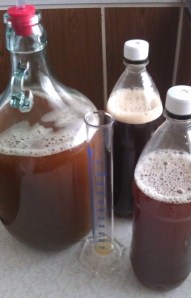
Australian IPA #1 & not-beers

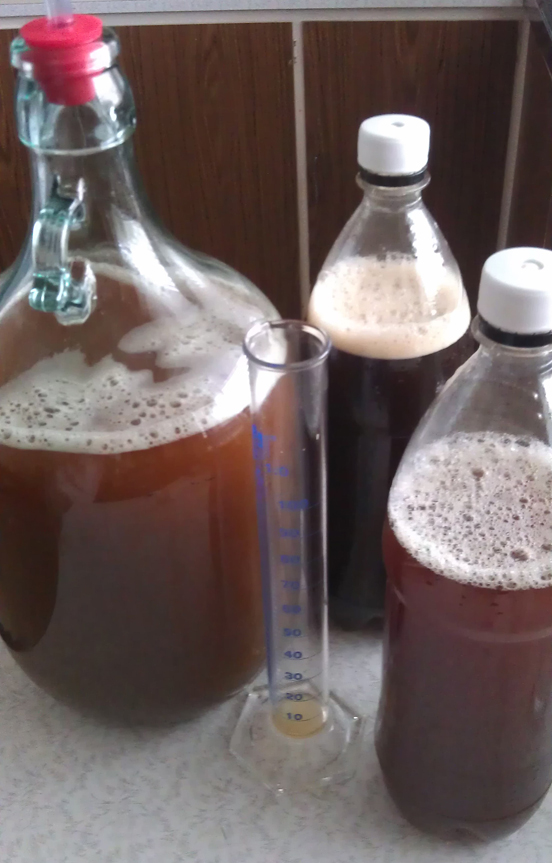
Australian IPA #1 and the two not-beers ready to ferment

Chilling went very well. The two litres of half frozen ice and just over half a tray of ice cubes went straight into the pot. The pot also sat in the ice bath to help further. When it came to getting the wort into the carboy I tried something extra. Used a muslin bag for extra filtering. Put this at the bottom of the funnel. So, pot into sieve on funnel in muslin bag in carboy. Should have got a photo.

Shook up the carboy before taking a gravity reading. Was a respectable 1.058, just shy of target. Yeast was pitched, yeast nutrient put in, carboy given another shake, and airlock put on. First brew done.

Onto the non-beers! Let me give you some context. My wife loves malty beers and doesn’t like hoppy beers. The question was raised “could you make a beer without hops?” Well, you could technically make a brew without hops. Not sure if you would still call it a beer. Not sure if it would taste any good. Anyway, I decided to make two very small batches of no hop beer.
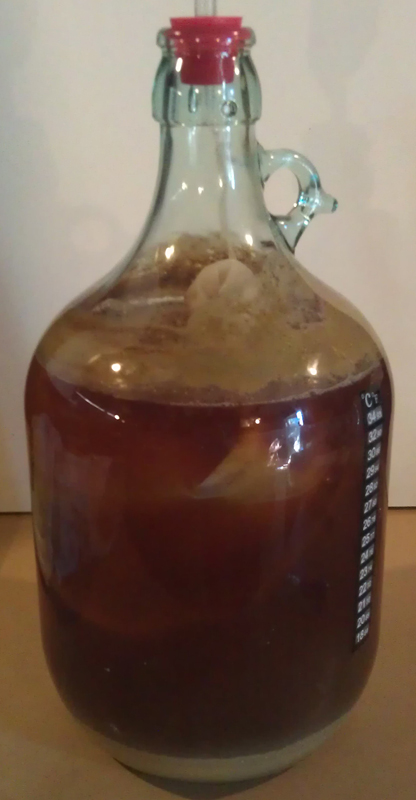
Australian IPA #1 with hop bag

Australian IPA #1 after three days with the hop bag

The first batch was with dry amber malt extract. Very easy. Boil water. Chuck in malt. Bring it to a hot break. Heat off. Cool in an ice bath. Put in fermentation vessel. Pitch yeast. Add yeast nutrient. Shake. Seal with airlock. Done.

Second batch was done with dry dark malt extract. Both were about 1.2 litres. Both went into soft drink bottles with Pat Mack’s Home Brewing Caps. Perfect set up for these super small experiments. After fermentation I’ll put these in glass bottles to condition.

After three days I went back to the Australian IPA. Time to dry hop. Was planning a 4 grams addition of Amarillo and Citra with a 50/50 split . Worked out a lot closer to 4 grams Amarillo and 3 grams Citra. Whoops. Hope that’s not too much. Ah well, I can just leave it a month to settle before drinking a bottle.

Was quite a good day. Great to have Ian around again. Glad to do a brew with some grains again. And happy to get the not-beers fermenting, even if I’m dreading what they’ll taste like. Talking of taste, the wort for the IPA was very hoppy and undrinkable. Good a sign. Will let you know how that one develops.

-Mikey

Tagged , , , , , , , , , ,

Imperial Red Ale – review

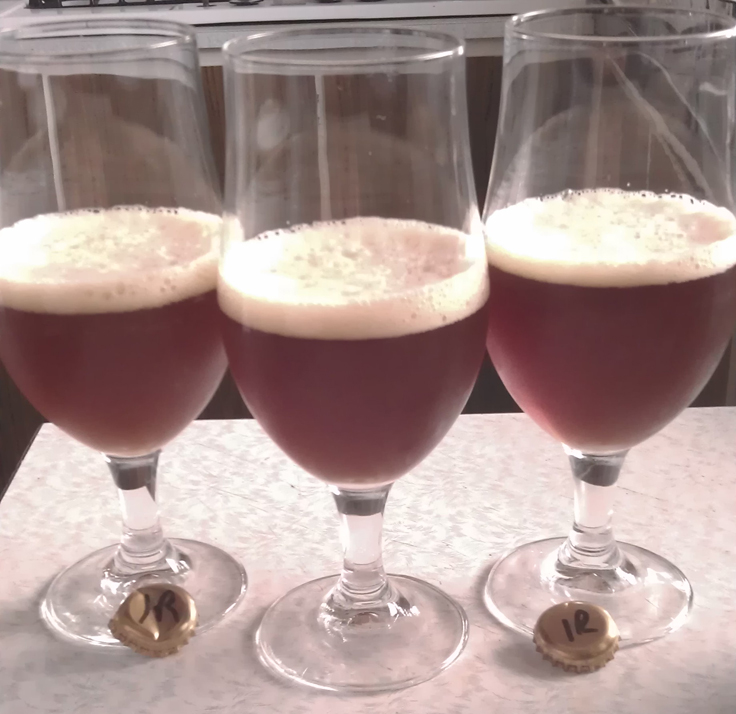
Back in January Chas decided to to do a big batch of the Iron Curtin Imperial Red Ale. It was in the middle of a bit of a heat wave in Melbourne and the brew could have ended up quite a mess. The beer had a bit of steeping grain for flavour, liquid malt kit, extra liquid malt, some dry malt and a bit of hops for extra kick. Although it was a kit a lot that went into it. Fast forward four weeks in the bottle, it was time to do a taste test.

Iron Curtain Imperial Red Ale

Three glasses of Iron Curtain Imperial Red Ale ready for drinking

The smell is about exactly what you would expect for a red ale. There’s that rusty malt and sweetness aroma. Quite a solid aroma, too.

Flavour comes on with a build up which works well. Amber malt flavours building with the slight spiced hops. It’s balanced really well and works a treat. The beer is big and there’s a feeling like your mouth is full of flavour. A hint of sweetness sits behind the main parts. At the end it gets a little less balanced with the bitterness finally overpowering the malt. Just at the very end there’s a bit of funky tart flavour, probably due to the yeast.

For food matching is pretty easy. If you come home after a long day, work or whatever, and you’re really hungry you have something that fills you up. Whatever that food is, this beer will match it. This is that beer for your wholesome meal. And it’s also a beer to slowly drink on a lazy night.

I’m pretty impressed with this beer. It was a kit, and I’m always a bit uncertain if they turn out they way you want. This one worked well. Quite well. I suspect these will dissapear pretty quickly.

-Mikey

Tagged , , , ,

Back with more everything, and the Secret

Enough feeling sorry for myself, time to brew. Back on Saturday 9th we had a brew day at my place. It was a huge fun day, even if the brew we made was only four litres.

I finally managed to get my good mate Ian around for a brew day. Chas made it and my friend Michael was able to join us as well, which made four on the day. More than needed to bottle the cider and the new brew. So, plenty of mucking around was had.

First order of business was bottling the Sneaky Cider. Was another bulk priming job, I don’t think I’ll go back to individual bottle priming. Cider from carboy into the small fermenter with the sugar. Then bottled straight from there. I decided to continue my experiments with soft drink bottles. We filled two 1.25L bottles and the rest filled six stubbies.

Gravity came in at 1.004 which I’m really happy about. Was trying to keep the sweetness low on this. Bulk priming was done with possibly a bit too much sugar, will see. End result should be a cider of 7.8-7.9%. That’s a big kick for such little effort. Nice.

Onto the beer. Due to the mess that is Melbourne weather, I wanted to make sure this brew could be kept cool like the cider. That meant another small batch in the carboy. So, picking up from where I left off it was time for another Australian Pale Ale experiment.

A bit of a side note, I’ve been a little obsessed the last six months or longer with a new Australian hop variety. It’s called Vic Secret (or Victoria Secret, depending on who you ask) and first time I had it in a beer I was blown away. This popped up back in 2012 in a collaboration beer simple called Victoria’s Secret by Beer Here and Northdown (now Edge). A single hop beer. I only had one bottle and really liked it. The beer has just been re-released under the Edge name, with a slight tweak to the recipe. Since then there have been a few other breweries bring out beers with this new hop type. Anyway, I have been trying to get my hands on this stuff so I can make a single hop beer. It’s been very hard to find with a lot of home brew shops not even aware it exists. Then finally a friend found a place that has some. And now I have some.

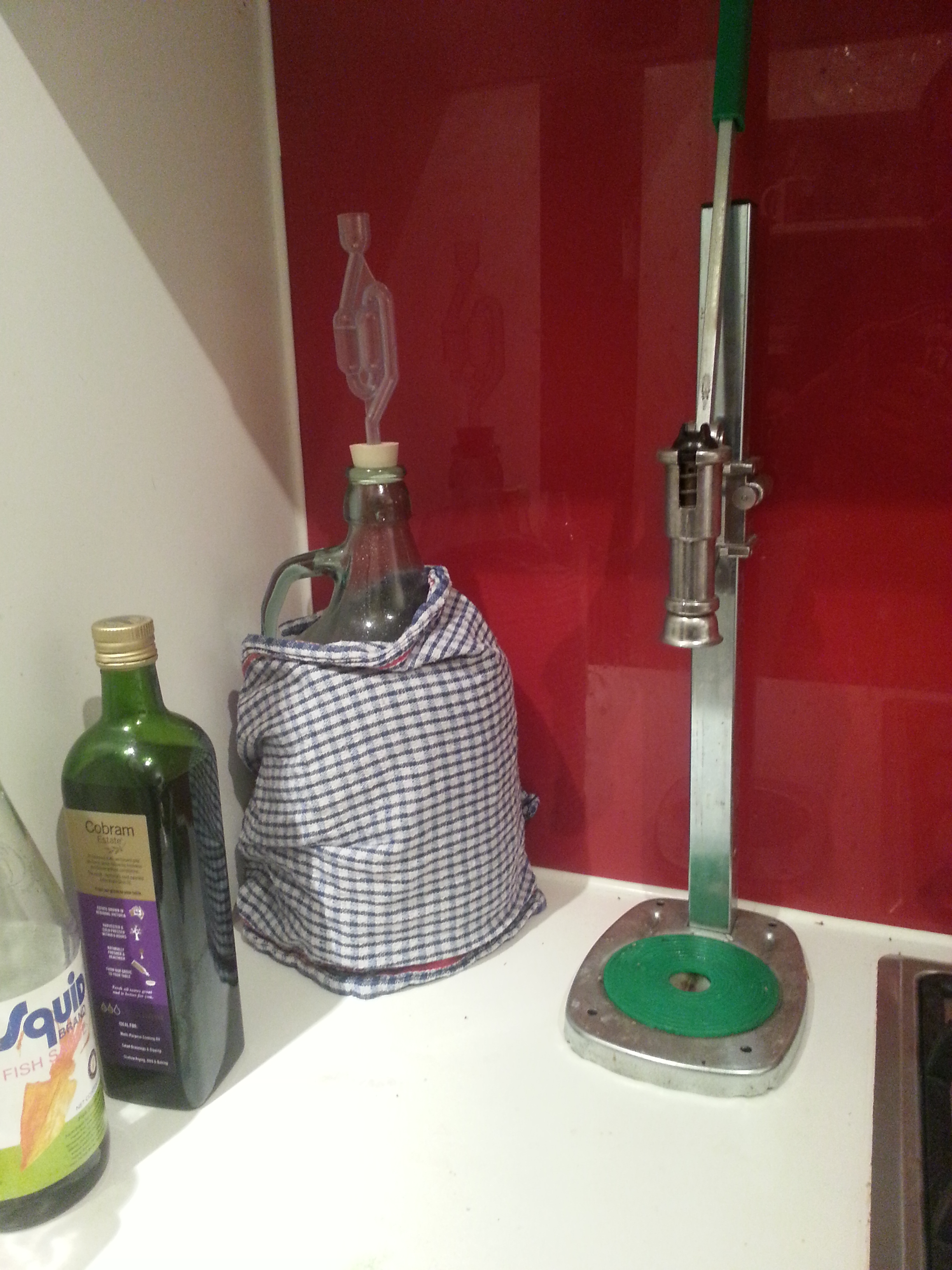
Australian Pale Ale 4

Australian Pale Ale 4 in the carboy (with ice packs) after 3 days

Australian Pale Ale #4 is a single hop beer. That hop is Vic Secret. The hop is quite high on alpha acid, the bitterness. I was using the same base, light dry malt extract, as I did for the last two Australian Pale Ales. Hop additions were done at 30 mins, 15 mins and 1 min. Nice and simple.

  • 3 litre boil, topped up to 4 litre batch
  • 500 grams Light Dry Malt Extract
  • 3 grams Victoria’s Secret hops @ 30 mins
  • 2 grams Victoria’s Secret hops @ 15 mins
  • 2 grams Victoria’s Secret hops @ 1 mins
  • 1 Teaspoon of re-hydrated US-05 yeast

Michael suggested that the middle hop addition isn’t needed. He’s been doing a fair bit of research into brewing, does a bit of home brewing and has been helping out at some breweries. The idea behind not doing the mid point hop addition is that you’re not really adding any flavour. You can get this from the last hop addition. And you get more bitterness from the first addition. Or that’s the theory. Might give it a go. Expect a post dedicated to this, at some point in the next few months.

Chilling was a quick one. Having these small batches makes it a lot easier. This time there was a lot going on. Two trays of ice and an ice cream container of half frozen water went straight in. The pot sat in it’s bath to chill with ice packs.

Gravity came out at 1.038. Was originally disappointed. There’s a good chance that the sample taken for the reading wasn’t the best. After pouring the wort liquid into the carboy I top it off with water. You’re suppose to shake it before taking a sample so you get something mixed. This wasn’t done. Comparing it to both Australian Pale Ale #2 (1.044) and #3 (1.046), this was low. To put that in a bit if context, the difference of 0.008 in gravity is approximately equal to 1% alcohol. That alcohol helps give the beer a better body. Hope #4 turns out fine.

Like the last few brews the yeast was rehydrated. Somewhere around 1-2 cups of boiled water was put in a glass jug, covered and left to cool. Not sure what it got down to, maybe as low as 25°C. Then a teaspoon of yeast was put in. And to speed things up a teaspoon of the dry malt was also put in. That’s a very small yeast starter. By the time it went into the carboy there was already a bit of a krausen, yeast head.

Yeast in, airlock on, carboy into the big pot of water. Done.

This was a really fun day. Great company, lots of drinks (review of the Iron Curtain Imperial Red Ale within the week), BBQ chicken for lunch, some really dodgy music, and not a tricky brew. Hoping there’s a lot more days like this in the future.

And I’ll be bottling tomorrow. Exciting.

-Mikey

Tagged , , , , , , ,