Tag Archives: home brew

Same-same, but different

Brewing day. Ah, nice to have one that doesn’t involve having to fill 80+ bottles. Due to craziness, ie doing other stuff, brew day was moved to Saturday. Plus there was no need to do a supply run which always saves a fair bit of time.
Australian Pale Ale #1

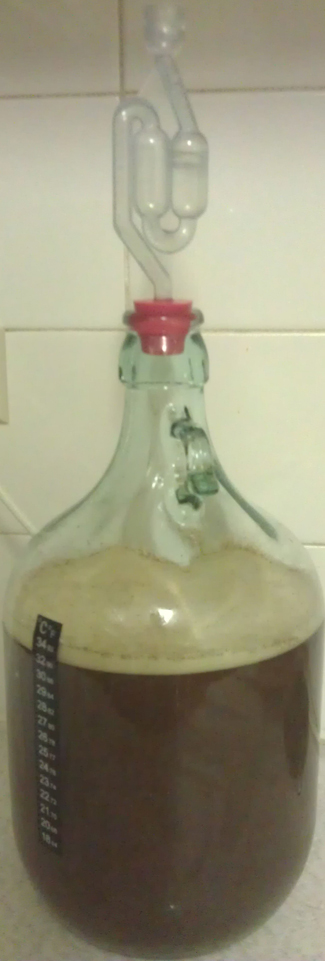
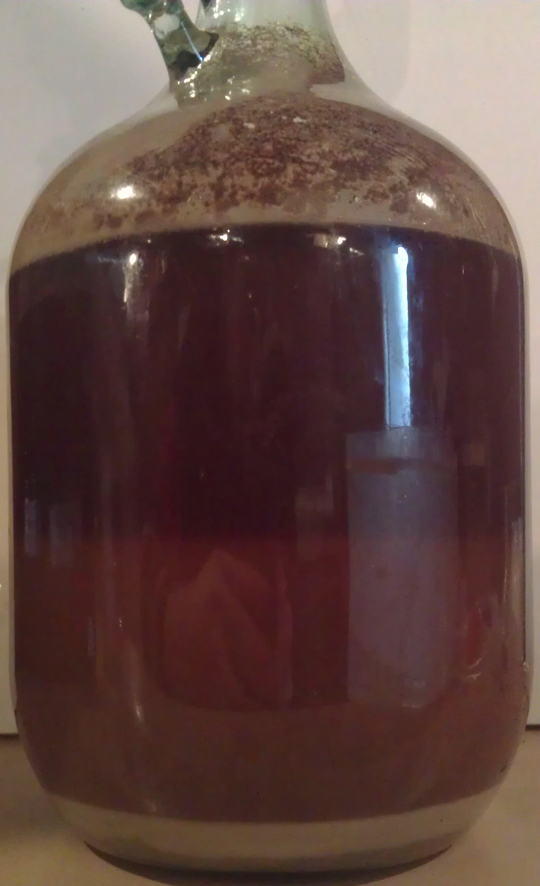
Australian Pale Ale #1 in carboy with separation after 2 weeks.

In the last brew we made the Australian Pale Ale #1. This was an experiment to see what could be done with just a can of liquid malt and hops. It was an attempt to make a very simple but still tasty home brew beer. Last time it was a can of light malt, this time amber malt. Rest of the recipe was the same. Same hops, same boil time, same yeast. Well, the yeast was slight different combination and I’ll explain a bit further down.

So, bottling the Australian Pale Ale #1 was quick. Only 12 bottles used, and the last one wasn’t a full one. There was a huge amount of sediment on the bottom and the brew looked like it had separated at the half way point. Not sure what that was about. There’s the pic to the side here. Anyway, we did a quick stir to mix the two half’s together before bottling. Due to the massive amount of yeast the bottles were very cloudy. I’m not sure how much sugar wasn’t fermented and this is the first time I’m a bit concerned about exploding bottles. Very interesting that the final gravity reading came in at 1.040. That’s high, very high. I’m thinking it’s mainly to do with the huge amounts of yeast. Anyway it means the beer will be 8.6% after bottled. Yay, finally a strong beer.

After that was all done it was onto making the Australian Amber Ale #1. Yes, I know the names are basic and Chas comes up with some great ones. I just can’t be bothered until I get one that I’m happy to continually remake. Plus, the name says what it is.

Started with three litre boil and threw in the can of liquid amber malt. Start of boil added 3 grams of Warrior hops. Twenty mins latter added 2 grams of Galaxy hops. Then 15 mins later another 2 grams of Galaxy hops. Five more mins then flame out and into the sink for a cool bath. Once temperature was close to what was needed it was pored into the carboy and topped up with cold water. Chas got shaking with the carboy and gravity readying was done, 1.097. That’s less then the Australian Pale Ale #1 and I think it’s because a bit more water went into this at the end.

Australian Amber Ale #1

Australian Amber Ale #1 in carboy.

Yeast for the last beer was an issue. There was too much left and the SN9 wine yeast was only put in after 10 days which didn’t do much. So, for the Australian Amber Ale #1 there was a change in what was done. Only half of a kit yeast pack was put in, and the SN9 wine yeast was put in at the same time.

  • Black Rock Amber Liquid Malt Extract – 1.5kg
  • Warrior hops – 3g
  • Galaxy – 4g (split)
  • Kit ‘Premium Brewing Yeast’ – 2.5g
  • ‘Premium Wine Yeast’ SN9 – 1g-ish

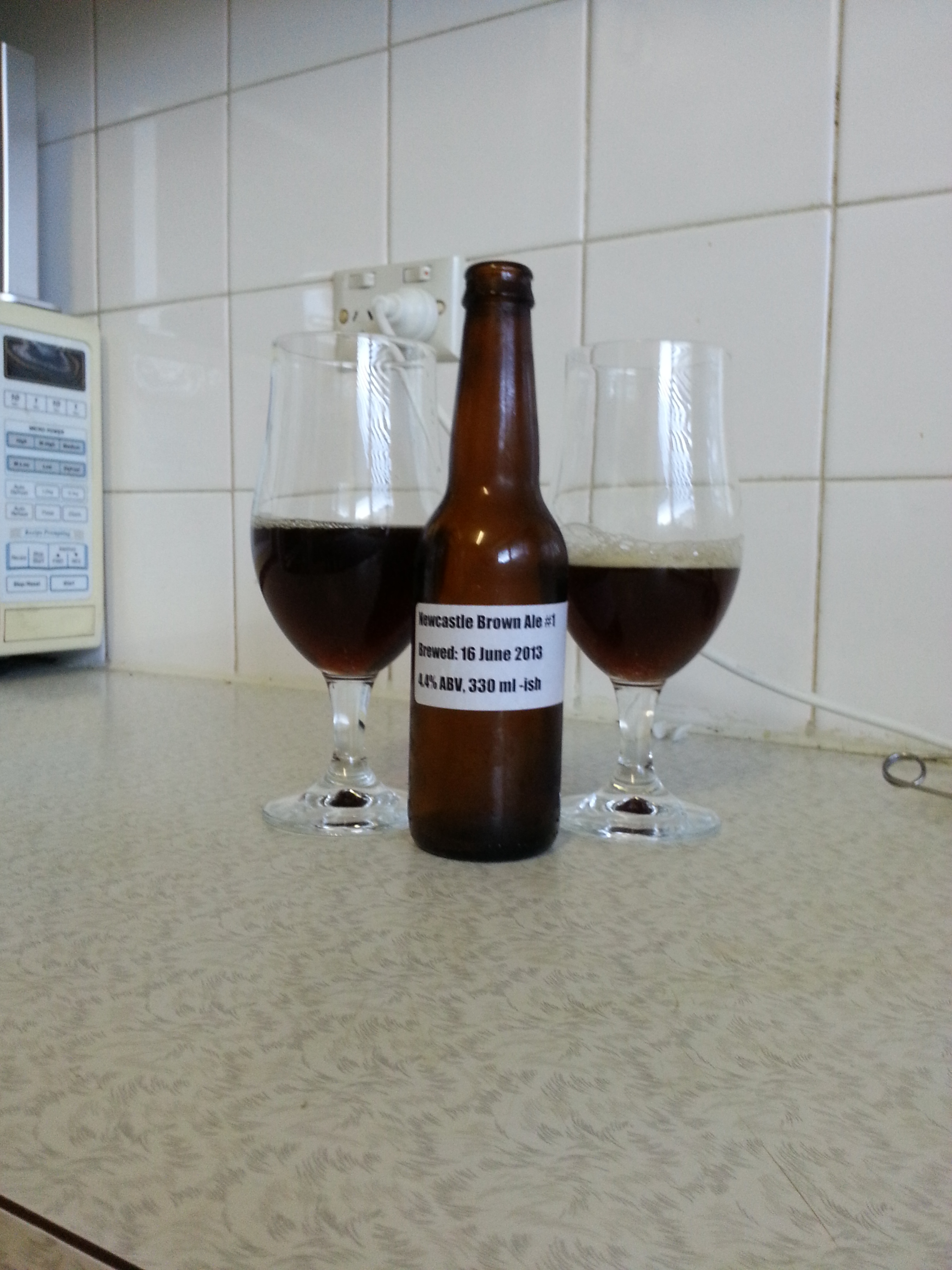
A good brew day was had. We busted out the Newcastle Brown and had a couple. Chas put up the review yesterday. Had a couple of the lagers, but one bottle was flat (no sugars in the bottle?). And opened a stout, but it’s not ready yet.

-Mikey
Tagged , , , , , , , , , , , , , ,

Newcastle Brown Ale – Review

Mikey and I made the Newcastle Brown Ale a few weeks ago and it’s finally ready for tasting.

This was a 23 litre kit that we bought.  It was a little bit more than a standard can of wort and a kilo of malt, but pretty similar.  Nice easy kit to make and it made a pretty decent beer as well.

Pouring it, the beer looked good.  Head retention was good, as was carbonation.brown ale

The nose was very crisp.  Floral and fruit smells were there, most likely from the Fuggles hops.  These were mostly melon and citrus smells.  This was mixed in with more earthy smell.  Generally though, the smell was mostly just bitter and crisp smells with a hint of sourness.

Drinking the beer, it’s notable how “standard” this beer is.  This isn’t a bad thing: it’s a good tasting British style brown ale.  It’s not trying to be anything it’s not, just an enjoyable beer.  Of course this makes for very easy drinking.  It would be easy to knock back a few of these.

Everything is very balanced.  There’s nothing terribly interesting about the hops; bitter and sour flavours throughout.  The earthy feel continues at the end.  In the middle, there is a hint of sweetness and malt which is where the body comes out.  Other flavours included burnt chocolate and citrus peel.

i would have liked a little more body, it just seems a little thin for me.  Checking back over the recipe, it seemed like there was a good amount of malt added: a can of liquid malt, some dry malt, and whatever was in the wort can.  Oh well…

I’d like this beer with some pizza I think.  Any food that is about medium in density – not heavy, not light.  Avoid a seafood pizza though.

-Chas

Tagged , , , , , , ,

The Beagle Double IPA – First Trial

For those familiar with the story of the IPA beer style, you’d know it’s characterised by being higher in the hops and alcohol.  This trend started when the British colonised India and were unable to transport their beloved pale ale from England to India without it spoiling.  Fortunately, hops and alcohol act as a natural preservative: so increase these two important beer ingredients, and your beer can go anywhere!

A double IPA, or an Imperial India Pale Ale, is generally even higher in hoppyness and alcohol than a standard IPA.  This should last even the longest sea journeys…

So, in honour of one of the great scientific sea journeys of all time and the boat, the HMS Beagle, today we made The Beagle Double IPA.

And before I go into the recipe, hopefully readers will have noticed the general theme going on in my beer names.  At the risk of starting a flame war with Mikey, at least my names are better than Mikey’s “Australian Pale Ale”.  Take that Mikey.

The trend of naming my beers after famous science figures is thanks to the proprietor of my favourite cafe, Husband.  So I’ll give credit where credit’s due.

Anyway, the recipe!

A friend of mine, Matt, had had some success with a simple mini-mash (edit, this is not actually a mini-mash recipe.  I’ll go into it another time.  i have a bad habbit of just saying “mash” if i use grains.  cheers Stu for keeping me honest) IPA recipe that called for a small grain bill of crystal, some dry malt extract, and two types of hops for bittering and aroma, but no dry hopping…  I need to have a chat to Matt about this as well, because the recipe called for a total of 50 grams of hops for a four litre batch.  Now I like hops as much as the next guy, but this would have just been nuts…  Mikey and I modified the recipe to our taste and sanity levels accordingly:

  • 75 grams crystal
  • 25 grams dark crystal
  • 30 grams rye
  • 1 kilogram golden light dry malt extract
  • 15 grams Citra – bittering hops; 60 minutes total boil
  • 10 grams Willamette – taste hops; 30 minutes total boil
  • 15 grams Amarillo – aroma hops; five mintues total boil
  • 10 grams Citra – dry hops; after two days
  • Safale yeast US05

Steep the grains in 1.5 litres of water in a grain bag for a total of one hour, keeping the temperature between about 70 and 80

It begins!

It begins!

degrees C.  This needs to go in at about thirty minutes into the boil, so start this first.  Personally, I prefer a grain bag but they’re not mandatory, it just makes things a little easier.

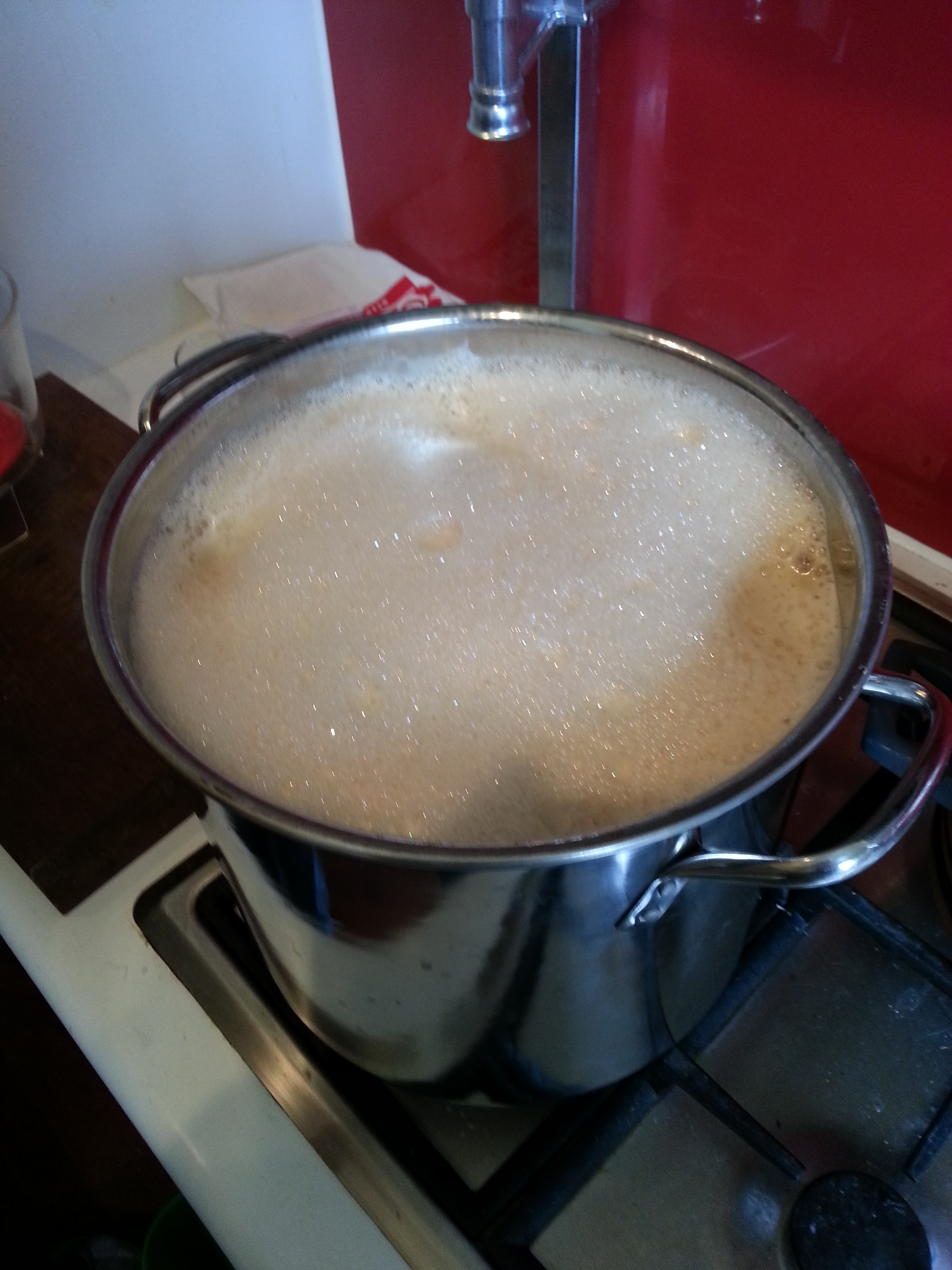
While the grain does its thing, boil 2.5 litres of water with the kilogram of malt extract.  We got a huge hot break, but that was mostly Mikey’s fault for purposefully making bubbles when stirring in the malt.  I’m glad we used the big pot.

At the hot break, throw the Citra in for a total of 60 minutes.

After thirty minutes, put in the Willamette and the water from the steeped grain.  Sparge the grain with about 0.5-1 litre of boiling water to make sure you get all the goodness.

Thanks Mikey...

Thanks Mikey…

Finally, with five minutes left in the boil, throw in the Amarillo.

Put the pot in a sink of cold water or use a wort chiller to get it to temperature, throw it all into a 5 litre carboy and top everything up to 4 litres in total.  Pitch the yeast and you’re done!

Don’t forget, after two days, add the second batch of Citra for dry hopping!

Other Brewing Notes:

We got a final gravity of 1.076, which I was pretty happy about.  With any luck, this should give an alcohol content of at least 7.5% ABV.  Because of this (and the general hoppyness), this is starting to get into the Double IPA range, so that’s what we’re calling it.

In regards to the hops, this recipe has three types of hops.

The Citra had a typical bittering hops smell: lots of bitter and spice aromas, with a bit of a tropical feel to it.  I find Citra a little more laid back than other bittering hops, but it’s definitively still there!  When this was first added to the wort, it didn’t do much to combat the malt smells, which were quite milky.

The Willamette was far more laid back than the Citra, a brief description of Willamette can be found in the Friedlieb Porter recipe.  Generally drier in smell.  With the Willamette, the malt smells were finally getting put in their place and the hops were finally starting to come through.  There was going to be a lot of spice in this beer.

20130728_143554Finally, the Amarillo had less bitter than anything else in there.  It’s a typical fruity hop for aroma.  The citrus really pushes through and there are a few earthy smells to it as well.  With the addition of the Amarillo, the malt finally lost the battle and the true IPA scent filled the kitchen.  Everything was much more balanced.

The wort tasted great, albeit, very sweet thanks to the very high gravity.  Of course the hops hadn’t had time to settle, so rather than get multiple notes, all there was was one big blast of bitter and spice – it hit and it hit hard.  I’d like to keep some of that for the final beer, but a little more subtle!  We’ll see what happens.

Anyway, great brew day.  Afterwards we went out for Mexican.  So for those wanting to re-produce this recipe exactly, go out for Mexican afterwards to ensure the same results.

-Chas

Tagged , , , , , , , , , ,

Brew day shenanigans and birthday presents

As per the Rules of Home Brew, while we were making a Double IPA today (recipe coming), we were drinking home brew while making home brew.  Also, as mentioned in our Wildly Inaccurate Facts About Beer, there can sometimes be a bit of down time during brewing, so we get a bit stupid.

20130728_133033

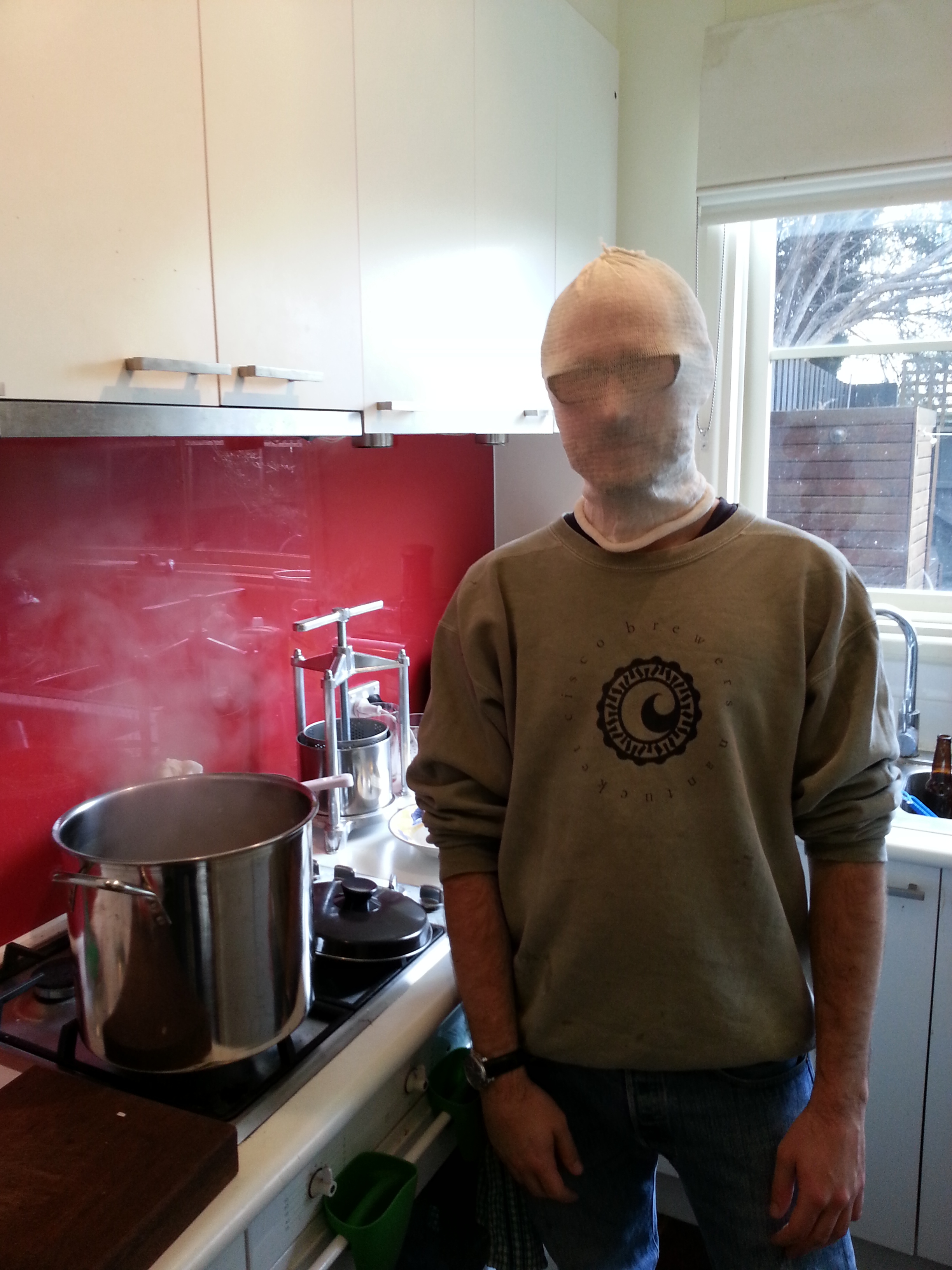
This is what happens when you have a spare grain bag and a few minutes to kill during the boil.  I was quite surprised at how hot I got in there.  I didn’t expect a grain bag to be so well insulating!

Anyway, I’m trying to start a new brewing fashion…

Oh, and for those who are a bit more observant, the metal contraption behind me is the brand new fruit press that my mom bought me for my birthday!  I haven’t been completely satisfied with how much juice I’m getting out of my juicer, as I mentioned when making some hopped cider, so hopefully this will do the job better.  It will surely get some use soon.

The press may not be robust enough to press full apples, but since the juicer ends up with so much pulp, it will come in handy for pressing any remaining juice out of the pulp.  I have found that the pulp holds a lot of juice, but it’s impossible to squeeze this out.  And obviously I can press other things as well!

That’s it from me until I finish off the new Double IPA recipe that we made today.

-Chas

PS.  Thanks again to my mother for taking me to the home brew store and basically letting me go nuts!

PPS. Sorry dad for not thanking you directly, but as awesome as the angle grinder is, this ain’t no power tool blog!

PPS.  My dad got me an angle grinder by the way… Thanks dad!

Tagged , , , , ,

Bottle day now with 20% more bottles, and a brew

Sunday was another brew day, of sorts. Really it was more of a bottling day with a brew at the end.

Australian Pale Ale 1

Australian Pale Ale 1 in the carboy

First order of business was to pick up some new supplies and equipment. My hydrometer broke last brew day and needed another. Needed some more no-rinse sanitizer. Plus picked up some liquid malt, hops (Warrior & Galaxy) and carbonation drops. Decided to go for more carbonation drops as I didn’t want to prime by measuring sugar, and was too lazy to work out how to do bulk priming.

Once back, it was onwards to the bottling. First up was the last 5 odd litres of the Newcastle brown. That was okay. Got 15 bottles in.

Next was the Stout. Gravity reading came in at 1.020 which means after bottling it will only be 4.0% ABV. That’s pretty low for a Stout. Might even need to call it a dark porter. Anyway, we needed to bottle all of it. ALL 23 litres! That’s 68 stubbies! Needless to say, this took most of the day.

Had a couple of breaks along the way. Got to try Chas’s coffee porter. Cracked open a bottle off the Newcastle brown, but it wasn’t ready yet.

Finally after bottling was done we moved onto brewing. For the past couple if weeks I’ve been thinking about how to get a very strong beer and still keep it easy. There’s a couple ways you can go about doing that, and hopefully over the next few months we’ll try as many of those options as we can. To make sure nothing too crazy is done I’m using a home brewing spreadsheet that let’s you put in ingredients and it tells you what characteristics of the beer will be. It’s amazing and I highly recommend getting your hands on it. You will need to sign up to Aussie Home Brewer if you haven’t already.

Anyway, this time around the brew was going to be a 4.5 litres batch for the carboy. Was using liquid malt extract that hadn’t been hopped and doing a 40 min boil with three hop additions.There was a whole 1.5kg can of liquid malt that went in. For a brew this small that’s right on the edge of madness, but I was keen to do this as a real test if a few things.

For lack of a better name, this is getting called Australian Pale Ale #1.

A big pot was filled with 3 litres of water, set to heat and LME was added. After the hot break added 3g of the Warrior hops. Twenty mins later added 2g of Galaxy hops, then last 2g of Galaxy was added 5 mins to the end. When the liquid malt went in the can was washed out with some boiled water. Not sure how much, but originally I was concerned we had to much liquid. In the end a lot boiled off leaving something just over four litres left. Given there was so much heat it took quite some time for the wort to cool down. The pot went through two long cold baths to get down to 22C. As there was a lot more liquid boiled off, I needed to top up the carboy with some extra water. Then I took a sample for a gravity reading.

Yeast was pitched. Used a whole pack of kit yeast as I had some spare lying around. Then give the whole thing a good shake, BrewSmith style.

Then, I checked my gravity reading and it was much lower than expected. Ahhh! I didn’t mix my wort properly. So, get rid of the sample and took another, which took out some of the yeast. But, that’s okay ‘cos there was a huge amount of yeast. Anyway the gravity came in a whopping 1.102!!

  • Black Light Liquid Malt Extract – 1.5kg
  • Warrior hops – 3g
  • Galaxy – 4g (split)
  • Kit ‘Premium Brewing Yeast’ – 5g

So, a few days in and the brew its going well. Huge amount of activity, but no blow out (lucky). From what’s coming out of the airlock, it smells great. Thanks to Chas in about 4-5 days I’m going to throw in some SN9 ‘Premium Wine Yeast’. This will eat up the last of the sugars, and have something to carbonate the bottles.

-Mikey

Tagged , , , , , , , , , , , , , , ,

Trappist Afterland Russian Imperial Stout – review

Last weekend I saw a band called Trappist Afterland. Great band, good night; I’m not going to go into the music (because this is a beer blog!), but the band have done something novel with their new EP.

Trappist Afterland’s new EP is available for digital download, so they figured at the launch event, rather than selling a piece of paper with the download code on it, they attached said code to a bottle of home made beer – so every album came with the gift of beer, the greatest gift of all (other than the lovely music).

Singer/songwriter for the band, Adam Cole, explained the idea behind releasing the album with the beer:

“Being a massive beer enthusiast I liked the idea of releasing

the album with a beer to reinforce the sip and listen idea.

Great beer and good music are the ideal partners I reckon.  

And considering our band name was inspired by Abbey Ales

it seemed to fit well.”

Adam also mentioned prior to the set that he had made so much beer, he may as well do something with it!

This particular beer was made at a brew on premises (“BOP” according to the tax man) joint called Barleycorn Brewers in Oakleigh South in Melbourne. I’ve never done brew on premises, but Mikey has. Basically, rather than making it at home, a BOP has all the equipment and recipes there for you. It can be a great way to get started or if you don’t have the room at home. They generally allow you to make a very good quality beer.

20130720_102542

Tasty beer sitting in front of some tasty cider in the carboy

This beer was no exception.

Firstly, the beer was highly excitable. It was one of those stouts that had to be poured a little, wait for the foam to die down, pour, wait some more, and so on. Once the waiting game was over, what was left was a dark, thick stout with lots of body, but not too heavy.

On the nose, there were some great malt smells. There was a nice crisp clean smell, most likely brought on by the hops, and a smell of sweeter fruits.

This slight sweetness/fruit continued on in the taste, which was fairly unexpected for a stout. It went well, although sometimes felt a little inappropriate given the style of the beer. There was also a little bit of chocolate which went well with these flavours.

Of course this was complimented by the general stout bitterness. There was also a bit of spice in the hops, which I generally like in a stout. Basically, there were a few great flavours in there all interacting.

This seemed like a well designed stout, especially for those new to stouts. It was good, but very “safe”, easy, and inoffensive. All of this enhanced drinkability and made it a surprisingly sessionable heavy beer. Although I love a good stout, I’m usually done after one or two; I could have done a few of these.

Because of all of this, this beer would make a good dessert beer. The sweeter fruit flavours would go well with a drier dessert like a cake or just generally with sweet fruits. Going with a more sour/tart fruit probably wouldn’t go as well, but it might work well with some berries.

Anyway, thanks again to Trappist Afterland for sharing their great music and great brew. I highly recommend both.

-Chas

Tagged , , , , , , , , , ,

Dead Guy Dark Ale – Review

As the first darker beer that wasn’t a BrewSmith kit and the first 23 litre batch that wasn’t a lager, there was a lot riding on this being a success. I think we can say the Dead Guy Dark Ale met the challenge.

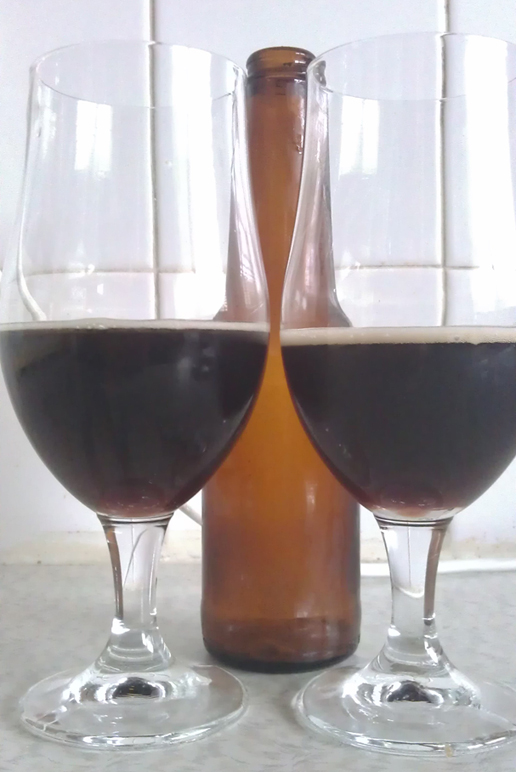
Dead Guy Dark Ale

Dead Guy Dark Ale in glasses

This is a dark ale. Not a brown and not a porter. It’s important to make the distinction because they are trying to do different things. Dark ales are generally the area between Brown Ales and Porters. Not as sweet/nutty/spicy as brown and lighter than a porter.

Up front there’s a dark sweetness aroma. Sort of like a caramelised sugar smell. It’s saying “hey, I’m pretty tasty so come and try”.
Lots of dark malt flavours. Not a huge body or overwhelming. There’s a slight sweetness across the beer which works well. Bit of smoke and darkness up front. The dark malt builds in the middle and then lasts quite a bit. Really enjoy this.

Would be matched with any meal that would be defined as “hearty”. Meat pie, beef casserole, thick spaghetti Bolognese, lamb roast, jacket potato, …you get the idea.

Because this is lighter than a porter it’s easy to drink. Works well as a food beer or to knock back at a party.

-Mikey

Tagged , , , , ,

Malted Cider – Review

Malted Cider

Malted Cider in glasses

A while ago Chas ordered some malt for a brew and it exploded in the mail. A replacement of malt was sent, and about half of the original malt was still left. What a great opportunity to add malt to something, like a cider.

I’m no fan of ciders. I’ve made that view quite clear. But the rhubarb and apple cider Chas made was nice and enjoyable. So, I went into this with an open mind.

The first thing I noticed with the cider was an unpleasant off egg smell. Chas ensures me that the other bottles are fine and don’t have any eggyness.

The flavour was okay. Apple sweetness right up front, then a slight sour taste. After that the malt comes through a bit. There’s a bit of egg taste at the end which isn’t nice. The body holds well and if it wasn’t for the egg I might enjoy this.

Not sure what food to match this with. The dud bottle makes it harder. I’m thinking Italian, maybe a spicy and/or greasy pizza. Might work with a red meat Mexican dish like tacos or burritos.

I would like to have another one of these ciders. I think this could be tweaked to make it quite nice. As long as the bottle is good.

-Mikey

Tagged , , , , , , ,

Chocolate Paradise Porter (with coffee) – Review

A little while ago, we modified the standard BrewSmith Chocolate Paradise Porter to contain coffee.  For those interested, the original Chocoalte Paradise Porter brew is here, while the review is here.

Overall, the beer turned out great.  We only made twelve bottles, and by the time tasting day came around, there were only three bottles left because Mikey’s wife (AKA Manager for Change Management/Director of Art Direction for this blog) had made her way through the rest of it!  I think she enjoyed it…

Anyway, the original taste prior to bottling was encouraging, although there was a lot of coffee in there, and it was slightly overwhelming.  After the beer was allowed to condition for a few weeks in the bottle, the overpowering flavours calmed down quite a bit.

20130707_153019The coffee was still quite obvious at first, and it really sat in my mouth.  This died down after awhile though and I started to get used to it, which allowed the other flavours to come out.  As the coffee died down, the brown sugar (which was another addition to the recipe) began to come out, but only slightly.  The brown sugar was more of a tease than an actual taste: it never came to the front.

The smoke, which was apparent in the original recipe, added a great twist as well.  It really began to compete with the coffee and add some a great interaction of different flavours.

Unfortunately, all of this tended to mask the chocolate somewhat.  The chocolate was still, but hard to find, and didn’t come out until the beer was allowed to breath for a bit.

In regards to smell, the beer was nowhere near as fragrant as it was with the original recipe.  As I mentioned, the taste before bottling had quite a bit of coffee to it, but the strong coffee smell went away with conditioning; I was really hoping for lots of coffee and peat to it, but it wasn’t there unless you really went looking for it.  There was also a little bit of spice and brown sugar in there to.  Although very subdued, the beer smelled fantastic.  I would have liked the nose to be bigger though.

All in all, this beer was full of great things, and they all complimented each other well.  It was great that there were different layers of flavour, some very obvious, some very subtle.  Sometimes the taste of something would come out of nowhere, and then wouldn’t return on the next sip.  It was a great and surprising beer.

Finally, it was great to see how a few very simple modifications could dramatically change a beer.  The original was good, the modification was better.


-Chas

Tagged , , , , , , , ,

Gauss’ Law – Hopped Cider

As mentioned, I made some cider this weekend!  Mikey doesn’t believe in cider so I had the aid of my friend who shall be referred to as the Cider Minion.  Although I’ve done brews on my own before, having a second pair of hands is always helpful, and Cider Minion was no exception.

I had originally wanted to do a proper batch of the Apple and Rhubarb Cider I made awhile ago.  The original brew was a bit haphazard so I didn’t do a recipe write up of it.  Unfortunately I couldn’t find any rhubarb, but I did have some left over hops from a porter we made, so I decided to make a hopped cider.

Judging from the Apple and Rhubarb Cider, this stuff was going to be strong; I was aiming for at least 10% alcohol.  I wanted to make this cider stronger than the previous version because I thought a little alcohol burn would add to the taste and feel of the beverage.  So I’ve decided to call this cider Gauss’ Law based on a really bad pun that I’m not going to go into.  Puns are awesome by the way.

Ingredients

  • 7 kg of Golden Delicious Apples
  • 1 cup dextrose
  • 4 grams Fuggles hops (bittering)
  • 2 grams Fuggles hops (aroma)
  • SN9 wine yeast

This was for a (what was supposed to be) a four litre batch.

Bring half a litre of water up to a boil and start steeping the bittering hops for 30 minutes.  At the 25 minute mark, add the aroma hops.

My juicer isn’t the most efficient machine in the world, so a better juicer or an apple press would probably require fewer apples, but I managed to get 3.5 litres of apple juice out of the apples, which is what I was after.  This 3.5 litres needs to be added to a separate pot from the hops and brought to a boil for about 15 minutes.  This will kill any bugs in the juice.

Once the hops are done, strain them into the juice.  Also add the dextrose (this can really be done at any time).

I was surprised this time around.  Previously I’ve gotten a pretty decent hot break out of boiling apple juice.  This wasn’t the case, even though I’ve used Golden Delicious apples before.  Oh well…

Once your juice has boiled for at least 15 minutes, put a lid on the pot and let it sit in a sink full of cold water for at least 20 minutes, changing the water regularly.

Throw all of this into a 5 litre fermenter and pitch the yeast and it’s done!

Unfortunately this process only left me with about 3.5 litres all up, even though I started with half a litre of water for steeping the hops and 3.5 litres of apple juice.  I guess I underestimated how much I would lose to evaporation in the boil, or I under measured things.

The OSG I got was right on 1.070, which wasn’t quite as high as I was hoping for.  The OSG on the Apple and Rhubard Cider (which didn’t have added dextrose) was 1.064, I was probably a little conservative with the dextrose.  The previous cider managed to get a FSG below 1, but I don’t quite expect that with this one because the hops are adding to the specific gravity (although only slightly).  My prediction is an alcohol content of about 9.5% after bottling.  It’s not quite what I wanted.

Anyway, that’s going to take at least two weeks in the carboy, then bottling, then tasting.  We’ll see how it turns out!

-Chas

Tagged , , , , , , , , ,