Tag Archives: Chas

Malted cider or un-hopped apple ale?

Hi everyone,

So as I mentioned in my last few posts, I have a juicer, and I have a bit of extra malt.  So why not try throwing some malt into some apple juice and see what happens?

20130518_145533I went down to my local market and found a pretty good deal on organic juicing apples, i.e. apples that aren’t pretty enough to sell as eating apples.  I bought a hell of a lot – about 7 kilograms!

I had read in various places that you get about 1 litre of juice from 1-2 kilograms of apples, so I thought that this would be enough for about 4 or 5 litres of juice.  Unfortunately I was pretty wrong and only got about 2 litres.  I’ve since found out that this ratio works better for apple pressing, which is a much more efficient method of extracting juice.  Using a juicer like I have tends to lose a lot of juice to the pulp it creates.

I’m not going to go out and buy a juice press, but next time I may try squeezing out the pulp.  We’ll see.

Anyway, after cutting up a whole bunch of apples and juicing them, I wasn’t left with the amount of juice I thought I’d get.  So from there, things began to turn into an un-hopped apple beer rather than a malted cider.

I set my 2 litres of juice to boil and added a cup of golden light liquid malt extract.  The hot break was huge on this one; the pot was only about a third full, and it still nearly boiled over!  Once that was under control, I let it boil for 15 minutes while I did some cleaning.

After the boil, I let the bottle sit in a sink full of ice water for 10 minutes, emptied the sink, and then filled it up again for another 10 minute bath.

Once this wort was in the carboy, I topped it up with about 2 litres of water – so this batch is going to be 4 litres in total.

Two litres juice, one cup malt, two litres water

Two litres juice, one cup malt, two litres water

The yeast i used was an SN9 wine yeast.  It’s what I had on hand, but, considering there’s malt in there, I probably should have gone and used an ale yeast. That’s something to experiment with later.

The wort was tasty.  It wasn’t overwhelmingly apple-y or beer-y, but had good hints of each.  So I’m confident I’ll get something interesting out this.

The OSG was 1.028, which is a little lower than I would have liked.  As a lot of that sugar is fructose, I should be able to get a final gravity pretty close to 1, so that’s promising.  Alcohol content should be around 4% after bottling.

I’d like to see if I can push the alcohol content a bit higher, so I might add some dextrose next time.  Of course the other option is adding more malt or juice, but, assuming the mixture of flavours is good, I don’t want to upset this balance.  Dextrose won’t alter the flavour.

Assuming this turns out tasty, I’ll also look at hopping it, which will make it a proper beer.

So we’ll give this a week and see what happens!

-Chas

Tagged , , , , , , , , ,

A malt explosion!

So I ordered a home brew kit from Australian Home Brewing.  I love ordering stuff online.  I don’t get much mail apart from bills, so it’s great to come home to a package on the doorstep; this is even better when the package contains home brew supplies!

Anyway, with much excitement, I opened my package, and, to my horror, found that the liquid malt container had broken in transit!  There was malt everywhere throughout the box, a total sticky mess.

Liquid malt everywhere!

Thankfully malt cleans up pretty easily with hot water (there’s a tip), so the other contents cleaned up pretty well. Unfortunately much of the malt extract was lost.

These things happen I suppose, but of course it’s disappointing to open a fresh box of home brew supplies to find your malt all over the place, and the rest of your ingredients all sticky.  When I moved it, some of the extract managed to drip through the box as well, getting malt throughout the house.  The dogs were quite pleased with this and helped with the clean up though.

Well, I sent a quick email off to Australian Home Brewing and they sent me a replacement malt right away.  They also threw in some liquor mix for the trouble, which was extra nice of them.  I would have been happy with just a replacement malt extract!

To make things even better, I managed to recover a little bit of the malt, probably just enough to throw into a small experimental batch in my 5 litre carboy.  It’s not enough for a full 23 litre batch, but enough to play with.

Moral of the story? When God gives you ruptured malt packages, make beer out of it!

Oh, and course the replacement was mailed to me as well, so I had the pleasure of coming home to another package.

– Chas

Tagged , , , , , ,

Hoppy Heart IPA – review

So we finally got to taste the Hoppy Heart IPA from Brewsmith that we brewed a few weeks ago. You can check out the post on the brew here.

The only problem with brewing is that it requires patience, which is something I don’t have.  You make your brew, wait while it sits in the fermenter, bottle it, then wait again!

Why not just go to the bottle shop and get something that’s already been made for you?  Well, that’s a whole lot less fun and you wouldn’t have the satisfaction of knowing it was something you’ve made yourself.  Also, home brew is tasty, and this IPA was no exception.

Hoppy Heart IPA #1

Hoppy Heart IPA #1

Firstly, I want to make a very loud shout out to the guys at Brewsmith.  It seems they stumbled upon this humble blog and posted an earlier review on their Facebook page.  I suppose it’s good for them to be showing potential customers that they make good beer, but it’s nice to be getting extra readers too, so everybody wins!  I know we refer to Brewsmith quite a bit around here, but just in case we forgot to give a link, here it is: http://brewsmith.com.au/ – that’s for all y’all who don’t know how to use search engines…

So the first exciting part of the weekend was getting some extra readers.  The second exciting part was trying the IPA while making some beer.

Well first of all, the colour was great: fairly dark with lots of body and head.  Mikey was doing a bit of a “yay we get to taste the IPA dance” prior to opening the first bottle, which made it get shaken up, so after dealing with that mess, we got to try the beer.

Getting ahead a little, but talking about the body of the beer, it seemed to have a bit of a creamy or oiliness about it.  It was a pleasant feeling, and I can only imagine that it may have come from the oils that come from the hops, but that is only a guess.  All in all, it added to the body of the beer.

In regards to smell, it was exactly like an IPA should smell like, fruity, hoppy, just generally nice. When drinking, I really got all the different levels of hops: aroma hops, taste hops, and bitterness hops.  The flavours were distinct, but together at the same time.  It was quite nice.

IPAs are most famous for their hoppy/bitter flavour, and this was no exception.  That being said, I’ve had some very bitter IPAs.  While I love lots of hops, this can be a little overpowering at times, and I can often only have one or two of these before I move on.  This was not one of those, rather, it was a bit more balanced and much easier to drink.

Adding to this was the fruitiness, which counteracted the bittering hops very well.  Sometimes one wins out, the fruit or the bitter, but this IPA had both at neither extreme.

As I finished the beer, I really began to notice the bitterness staying in my mouth, which is a lovely side effect of an IPA.  So the taste really stayed, which is great.

All in all, we were quite pleased with how this came out.  As with the Brewsmith porter we made a while ago, this beer was very easy drinking.

And finally, since the last review requested that I recommend food…  My first instinct would be to just enjoy this beer on its own.  It was very refreshing and good just for its own sake.  The bitterness in an IPA can push out other flavours, so it may not go well with something that’s less than bold.  So if you must drink it with food, drink it with something that will hit you just as hard.  Keep in mind that the beer also has fruit flavours as well.  A dry curry would go well, or perhaps something Mexican is what I’d go for.

– Chas

P.S.  and since this was an article about an IPA, here is a short list of hops related puns I wanted to include, but felt would be inappropriate in the main review:

  • We were very hoppy with how the beer came out.
  • When drinking the beer, I said “hip-hop-hooray, that’s good”
  • Something about rabbits?
  • Hop on the bandwagon, drink some IPA.
  • I got hopped up on some tasty home brew.
Tagged , , , , , , , ,

So I bought a juicer…

So I bought a juicer by mistake.

As you may be aware, juicers make juice.  If one pours this juice into a container, pitches some yeast, and then seals it with an airlock, one has a lovely cider.  This is why I bought a juicer. According to the instructions, I also have the option of drinking the juice before I ferment it, but I don’t see a reason why I would do such a thing…

My new juicer!

My new juicer!

So this thing is hardly top of the line, but it will get the job done.  I’ve opted for the model that can fit a whole apple down the chute, just in case I want to do that.  I’ve done some research on juicing – maybe if I really get into this whole cider thing I’ll discuss juicing methods at length.

I’ve looked into cider making and the process is pretty simple:

  1. Get/make juice.  If you’re using store-bought juice, be sure there are no preservatives. Preservatives will mess with the final taste and may kill your yeast.
  2. Set juice on a low boil for about 15 minutes.
  3. Cover pot and cool the juice as quickly as possible.  This can be done by placing the pot in a sink full of cold water/ice.  Change the water out after 10 minutes.  Ultimately you want the temperature to be below 30 degrees C (slightly warmish).
  4. Put juice in carboy or fermenter.
  5. Pitch yeast.
  6. Place lid and airlock.
  7. Magical process!
  8. Bottle as per beer.
  9. Magical process!
  10. Cider!

The whole purpose of this cider endeavor is to just play around with different fruits and see what happens, so I’ll keep you updated.  I’ve already got a small batch of apple and rhubarb going in my new 5 litre carboy.  I’m not going to do a full report on this one though as it was all really haphazard. If it turns out remotely OK, I’ll do a proper batch of it and give the full recipe.

I have already learned a few things:

  • Apple or pear is probably your best base.  Start with this for the bulk of your cider and add other things to taste.  Just be careful of too much citrus, the acid may kill your yeast.
  • Your local brew shop will have good quality apple or pear juice in concentrate if you want it.
  • Similar to glucose, fructose, which is the main sugar in fruits, will ferment completely. If a sugar ferments completely, it won’t leave any sweetness or taste – it will all turn to alcohol.
  • Fructose will break down into other non fermentable sugars if you cut the apples up and leave them to sit for about 24 hours.  So if you want a dry cider, juice the apples immediately, if you want a sweet cider, cut them and let them sit.
  • Just the pure juice gives a pretty good OSG (I got about 1.045).  Feel free to add some glucose if you need some extra kick though, it shouldn’t alter the taste since it will ferment completely.
  • Use a good wine yeast.  Your brew store should be able to recommend something.  Just remember, don’t use a beer yeast.

I want to do some brewing this weekend.  If Mikey is available, we may do a lager similar to the big batch we did a few weeks ago, but tweaking the recipe slightly.  Alternatively, if I’m able to get enough apples, I might have a play.

Then again, I haven’t discussed the prospect of Random Cider with Mikey – he may love or hate this idea, but if he loves it, we may end up making cider together.

Regardless, I’m going to start experimenting with Random Cider as time goes by.

-Chas

Tagged , , , , ,

Brewing, it’s in the blood

So I got an interesting story from my grandmother recently…

According to her, my great grandparents brewed their own beer and spirits during prohibition times way back when!  Unfortunately my grandmother couldn’t remember too many specifics – I doubt my grandmother would have been born yet by this point either.

Supposedly, my great grandparents were brewing in their apartment’s bathtub, which was relatively common during prohibition days

Everything was going well until their brew started leaking into their downstairs neighbours, which I imagined put at least a temporary stop to things.  What lucky neighbours though to be getting free beer dripping from their ceiling!

Anyway, things finally stopped once prohibition laws were repealed.  Oh well!  At least I can say I have tradition of brewing in my family.

-Chas

Tagged , , ,

Chocolate Paradise Porter – review

Chocolate Porter #2 tasting

Chocolate Paradise Porter #2 for tasting.

Howdy!

Well, as Mikey mentioned in his last post, we tasted a porter that he brewed a few weeks ago.  We had the drink while bottling an IPA from Brewsmith that we made about two weeks ago, and then followed by making yet ANOTHER Chocolate Paradise Porter.  So, following the first and second rules of home brew, we had to be drinking home brew.  Why not kill two birds and do a tasting at the same time?

I’ll start at the beginning: the taste before bottling.

It’s important to taste your beer before bottling to make sure that there is nothing funky going on.  It lets you know that it’s turned out OK and gives you a general idea of how things will turn out.

However, prior to bottling, the beer has generally been sitting at a fairly warm temperature (optimal for yeast) and is most definitively flat.  So yes, the first taste is a taste of a warm, flat beer.  The beer also hasn’t been given a chance to fully mature, so it’s far from done.

Prior to bottling, the smell was near perfect.  The chocolate really came out and there was a little bit of smokiness to it.  Exactly what a porter should smell like.

The first sip, however, was interesting… it had a sourness to it that although wasn’t bad, wasn’t good.  It didn’t taste like it was off or infected, but the sourness gave us a bit of a worry.  We figured the beer would lose this strange aspect after some time in the bottle.

The first (second and third!) bottle:

The nose didn’t change at all.  There wasn’t anywhere for it to go really.  It was still smokey with a bit of chocolate.

In the first few sips, there was still a hint of sourness to the brew, but it seemed to come from the carbonation.  The carbonation was a bit strange, and it seemed to sit on my tongue a bit.  Obviously carbonation is a good thing, but I don’t want it to be something I’m acutely aware of – especially in a porter.

Fortunately, this weird carbonation thing went away after the beer was allowed to breath for a few minutes.

The chocolate flavours were there, but overall very subtle.  The chocolate came through in the nose much more than in the taste.

What really came out in the taste was the smokiness.  It was great, although dominant. Unfortunately this meant that the any complexities in the beer were taken away somewhat.  This left us with what was still a great porter, but with nothing that stood out except for the smokiness. Please don’t get me wrong, this is far from a bad thing.

I had a few bottles of this, one served at what was probably the optimal porter temperature, one served a little cooler, and one served at temperature too cold for a porter.

Overall I think I liked the coldest one best.  I think that this was because I found the beer surprisingly light and refreshing for a porter.  Beer is always great and refreshing, but there are different styles for different times.  This porter was surprisingly light and quite easy drinking.

So overall, the beer turned out great.  Usually I can spend a little bit more time on a porter, but this one went down far too easily.  It wasn’t complex, but a complex beer can often be harder to drink.

All in all, a great beer, and I’m happy at how it came out.

Now let’s see if Mikey leaves a comment telling me I’m wrong…

-Chas

Tagged , , , , , ,

First adventures – keeping things warm

Howdy!

So it’s been about five days since we did the brew I talked about in my last post, and I’ve been relatively happy with the progress.

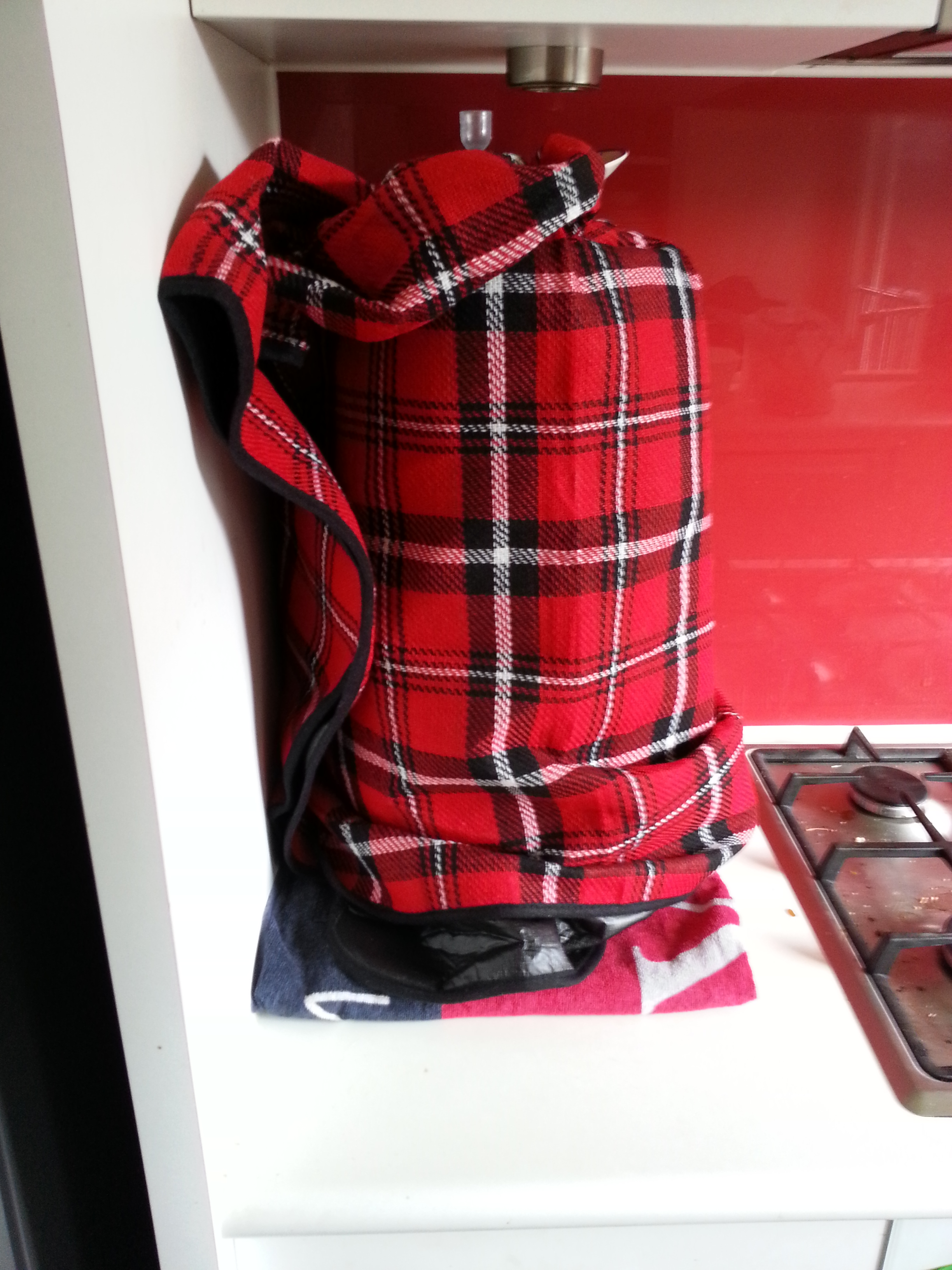
As I mentioned in my previous post, there was some concern about keeping everything warm enough during the fermentation process.  We were also worried about the morning sun hitting the fermenting tub: the UV can harm your yeast and make generally bad flavours.  To solve these two problems, the brew spent the week wrapped in a blanket:

Beer needs to me tucked in nice and tight when it gets sleepy.

Beer needs to be tucked in nice and tight when it gets sleepy.

This worked surprisingly well.  The yeast manages to produce some of its own heat during the fermentation process, so this blanket kept everything in.  Although my house got as low as about 13 degrees C over night, the wort consistently sat at about 22 degrees C when I checked it in the morning.  It could be a little warmer, but this is still a great temperature. And it was relatively constant, so that’s great.

Another alternative I’ve heard being used is to place your fermenter in an old bar fridge (not on). Refrigerators are extremely well insulated, so this method will keep everything warm (or cool), and more importantly constant.

In warmer months, this method can also be used to keep things cool, just don’t leave the refrigerator on constantly, otherwise things will be too cool.  If you get a fancy enough fridge (or a wine fridge), you may even be able to set it to work at a higher temperature.

Generally, the higher the temperature, the faster the fermentation process is – to a point obviously; if things get too hot, you’ll kill your yeast.  According to the packet, the yeast we used has an optimal temperature range of 21-28 degrees C.  So since the we’re running on the lower end of that scale, the fermentation process will probably take about eight or nine days.

So next step: bottling!  But that’s still a few days away…

-Chas

Tagged , , , , , , ,

First adventures in home brew

Thomas Coopers Heritage Lager

Thomas Coopers Heritage Lager and fermenter

Howdy!

My friend Mikey and I have recently decided to start making home brew. In this blog, we’ll be documenting our brews, sharing what we’ve learned, and hopefully stimulating some discussion and just generally see what happens.

Today, Mikey and I made our first 23 litre batch using a fairly standard starter kit that you can get from most home brew stores. We figured this was a good place to start. The kit came with pretty much everything you need, including a can of Thomas Coopers Australian Lager mix. We made a smaller batch last weekend, but I’ll let Mikey get into that.

These mix cans are a great place to start because it makes the process very easy, albeit probably a little bit too simple. This way though we were able to concentrate on the most important part of home brewing: sterilization.

If you’re interested in getting into home brewing, remember: sterilize EVERYTHING. If any nasties get into your wort, your beer will not turn out. So stay clean and err on the side of caution.

So from there it was just pour the contents of the can into the fermenter with two litres of boiling water – remember, let the can sit in some hot water for about 10-15 minutes, it makes it pour much easier. Pour in some dextrose, fill the the fermenter to 23 litres and you’re pretty much done.

When filling the fermenter, make sure the water is at about 20-25 degrees C before pitching your yeast. And of course make sure everything is stirred thoroughly.

Before pitching your yeast, make sure to take a hydrometer reading to get the original specific gravity (OSG) of the wort. Today we got an OSG of 1.038. The higher the OSG, the higher the alcohol content of the final brew. 1.038 is not terribly high, but it’s pretty good, and we should get a final alcohol content of about 4.5-5.5% or so.

Following that, pitch your yeast, stir that in, put the lid on the fermenter, place your airlock and you’re done… The whole process took about 45 minutes, not counting some initial cleaning and sanitizing.

The instructions said that the fermentation process should take about 6-8 days, but we’re anticipating longer as it’s a bit cool at the moment. Once all of that is done, it’s time for bottling!

While we wait, Mikey has another fermenter at his house as well as the same Coopers kit we used today. Rather than adding the dextrose supplied, we’re planning on using a malt extract to bring out a little more flavor. We’ll report in after we brew that.

-Chas

Tagged , , , ,