Category Archives: Experiments

Quick, get it bottled

No posts for 10 days! That’s not so good. Well time to end all that and talk about bottling the Australian Pale Ale #2.

This beer really should have been bottled last weekend. But, was away in Tassie having a nice long weekend. Now I’m back the beer needed to go in bottles. Given the last attempt at bulk priming I thought I would give it another crack on a smaller scale. It worked well.

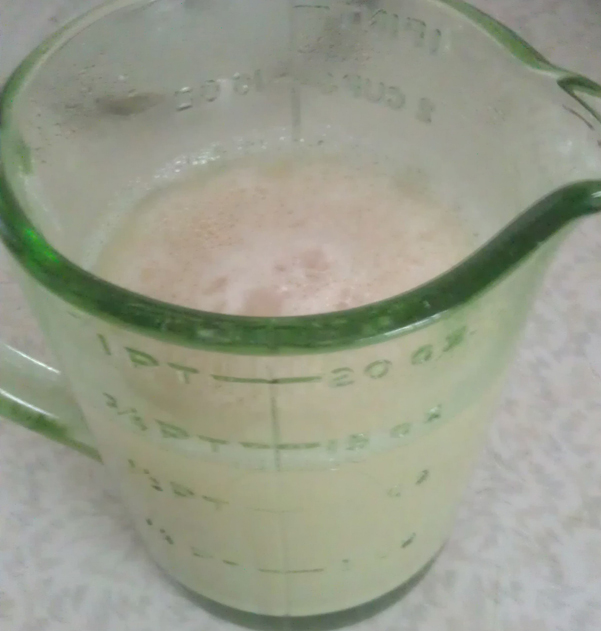
Australian Pale Ale 2 & sugar

Australian Pale Ale 2 ready for bottling and dissolved sugar ready for bulk priming.

There was only four litres of the beer so I could rack it all in one go. Plus I dissolved the sugar in some water first. How about that for planning? Dissolved sugar into pot, beer racked over the top, nice. With the beer in the pot it was just a matter of syphoning into the bottles. All up it took longer than if I just used carbonation drops. That said I’m more likely to be happy with the carbonation, if it’s even across all the bottles.

I’ve talked about how I want beers for festivals where normal beer bottles aren’t allowed. So, for this batch I’ve filled a 450 ml plastic bottle to see how the beer turns out compared to glass bottles. Will let you know what the verdict is.

The beer came in at 1.014 for the final gravity. I’m pretty happy with that as the last couple brews haven’t been that low. Beer should end up at about 4.4% alcohol after bottle conditioning, that’s pretty much what I was going for. Double win.

Having sampled the beer, it’s clear it needs time to settle. Lots of big bitterness. There’s plenty of sweet peach aroma and the flavour comes out as well. There’s way too much bitterness at the end, which I really hope drops away significantly. Looking forward to trying this in two, or maybe three. weeks.

-Mikey

Tagged , , ,

Bulk and Pale, finally there

Whoops, this was meant to go up a couple days ago! Anyway, here it is…

Last Sunday was another brew day at my place. It was a bit of a milestone date as I finally got around to doing bulk priming. Was also able to kick off what I hope is a series of pale ales. Chas made it over and we did a number if tastings through the arvo.

First up was bottling the Baltic Porter #2. As I promised, this was to be my first bulk priming attempt. There was about 15 litres of useable beer. Problem was that I didn’t have another vessel that could hold that much. Ended up using the 9 litre pot that’s normally reserved for the boil. Did two lots of 6 litres and one lot of 3 litres.

Bulk priming set up

First attempt at bulk priming with fermenter, scales, pot and sample in the back.

Used an online calculator to work out how much sugar to add. Sugar was put direct into the pot and beer was released over the top. Then stirred slowly to dissolve the sugar completely. In hindsight it would of been good to dissolve the sugar in some water first. Having just one vessel with one transfer would of been a lot easier. Bottling 15 litres with a syphon wasn’t fun. Most was done into 500 ml bottles which saved a fair bit of time.

The final gravity came in at 1.032 which is a lot higher than expected. After bottle conditioning it should be 5.6% alcohol. That’s a lower than was hoping for. Really wanted this to be above 6%. That said it tasted pretty good when we sampled it. Time will tell.

After bottling was finally done it was on to the brew. Plus there was a few brews up for tasting. The Aussie Wattle Pale Ale, Hoppy Heart IPA 2 and the two apple ciders I made. Chas will be posting about those over the next few days.

I’ve been wanting to build out a range of lighter beers that can be enjoyed on the warmer days coming up. Not everyone in the house likes IPA’s and I’m not ready for doing a proper lager. Pale ale was the only good option. Given the failure of the last attempt I decided to avoid using liquid malt. So, dry malt was used and hops kept tame. As I used up a few things last brew this ended up as a single hop beer. That’s pretty exciting and will be a great benchmark, if it ferments out well.

Before the brew started the yeast and a teaspoon of dry malt extract were thrown into a cup of water for rehydration. Realised after that should have waited before putting in the DME. Hopefully that doesn’t make much if a difference.

Basic brew this one. Only a thirty minute boil.

Australian Pale Ale #2
Boil size 3 litres
500 grams of Light Dry Malt Extract
3 grams Galaxy hops at 30 mins
2 grams Galaxy hops at 15 mins
2 grams Galaxy hops at 1 min /flameout.
1 & 1/2 teaspoons if US 05 yeast.

Australian Pale Ale #2

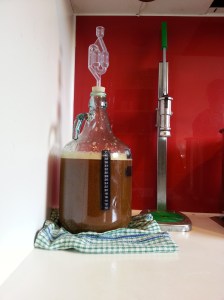
Australian Pale Ale 2 in the carboy after one week.

As this was a small boil it was a lot easier to lower the temperature. Three trays of ice and some half frozen water went into the wort while sitting in the water bath. In less than 20 mins we were already down to 24°C and ready to pitch yeast. Last bit of water put in to get it up to four litres then given a good shake before gravity reading done. Original Gravity came in at 1.044. Airlock on, and done.

Day was a good one. Had a late start and didn’t think it would be a long one. Turns out the bulk priming and bottling took a fair bit longer than I thought. Looks like I’ll need a proper vessel for the priming when I do it again.

Really happy to finally get around to these two things. Next few brews will also be pale ales. But might need to slow down as we come into Christmas.

-Mikey

Tagged , , , , , , , , , ,

New and old, recipe and brewer mix up

Saturday brew day was a long one, nearly 5 hours. I wanted to have another crack at the Baltic Porter. Chas wasn’t available so my mate Kilan came over to give me a hand.

Kilan has done a bit of home brewing over the last few years. Most of his equipment is in storage. He’s still been able to make some cider and brought over a bottle to share. Will talk about that later.

Was fun to have Kilan over for the arvo. We worked on a few things that neither of us had done before. Had a couple near misses and a whole heap of improvisation. By the end of the day we had bottled the Hoppy Heart IPA and brewed what we felt would be a really good beer.

The last time I did the Baltic Porter it was a 10 litre batch. The beer came out nice enough but lacked some body. The beer had a little too much sweetness. There was room to adds more complexity. In short, there was a lot that could be tweaked.

Baltic Porter #2 Mash

Baltic Porter #2
Grains in bag, in pot and mashing

Given the relative ease of the full grain mash at Chas’s last week I thought of trying a mini mash. The recipe was upping to a 17 litre batch and ingredients to match. That meant a lot more grain. Last time the recipe only had Crystal grains, which can’t mass by themselves. With advice from Chas I decided to include some Chocolate malt, which I believe can mash. So all 2kg of the grain went in to mash.

Kilian was a champ and crushed the chocolate malt grain. The only thing I had was a mortar and pestal which meant some grain got crushed. Hope that doesn’t make much difference.

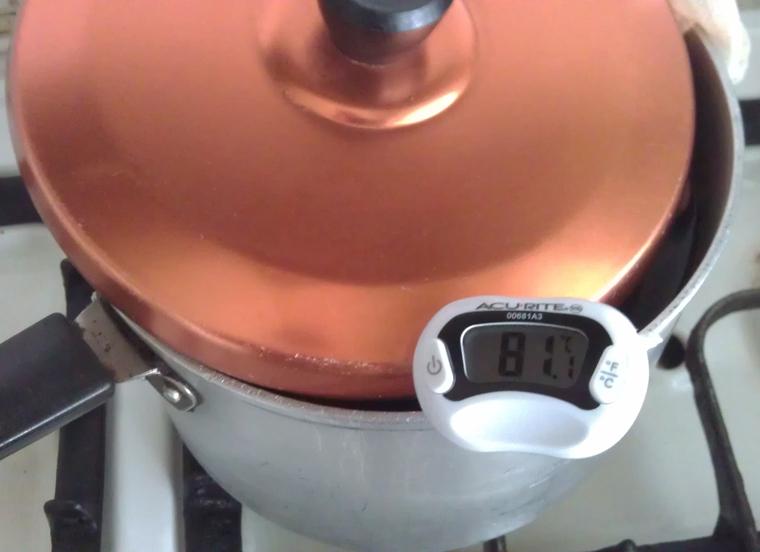
The Crystal grain went into a grain bag and into the pot. The Chocolate grain got thrown into the bag then all was stirred in. Mash was done at 68°C and had 5 litres of water. Wow, that grain soaked it all up and expanded like a balloon! Mash went for a full sixty mins.

While waiting for the mash to finish we bottled the Hoppy Heart IPA. The final gravity came in at 1.019. With the carbonation drops it will be 6.4% alcohol. And before you ask, yes I will move to bulk priming soon.

We opened the apple cider that Kilan brought. That was an interesting drink, and I mean that in all ways. We chilled it right down and was cold most of the time. First up it tasted like alcoholic orange juice, not like apple. Sort of super sweet and slightly tart. The smell was pretty bad, almost like something off. As it warmed up the cider became more like apple and more dry. Much better cold. I think something might have gone wrong with the yeast and / or fermentation. Let’s see euchre same thing happens to my cider.

Back to the brew, and mash was done. Only problem now was how to sparge the grain. And there was a huge amount. Was fortunate that the kettle we have at home has different temperature settings with the lowest being 75°C. So we used that and poured the water over the bag of grains. Each time we tried to press out as much liquid as possible, but we didn’t really have the right set up. After a few kettle’s worth of water at said temperature there was a lot of volume for the boil. I would have liked to do more sparging, but the boil pot just wouldn’t hold it all.

Baltic Porter #2 Grains

Baltic Porter #2
Grains ready for more sparging

So onto the boil. Earlier I realised that I didn’t have the exact amount of hops to do what I wanted. There wasn’t as much Warrior and that was suppose to be the bittering. As a compromise I moved some of the Fuggles from aroma stage to taste. By moving them earlier it should add a bit more bitterness, and hopefully balance. Will have to wait and see.

Once the boil started we re-hydrated the yeast. It’s the first time I’ve done this. It was pretty easy. The only problem is the water that was boiled so early on it cooled down too much. A quick zap in the microwave brought it back up to temperature. The yeast sat in the water while we dissolved the tea spoon of dry malt in half a glass of boiled water. Then waited half an hour before adding that in and gave it a mix.

I held off on adding the dry malt for a bit. Have been getting advice not to add all malt at the start of boils and wanted to try it out. As a result we didn’t get a hot break, it just came to a boil. Bittering hops went in at start, then taste hops at thirty minutes with the first 800 grams of dry malt a five minutes later. Another fifteen minutes later added in the last 400 grams of dry malt. Five mins after that the aroma hops. Then only five more mins before flame out.

Pot was transferred to an ice bath. Some ice cubes went directly into the wort, water previously boiled before frozen. A second bath for the pot. Then into the fermenter. Added a little more sparged grain liquid, that might not have been the best idea as I’m not sure if that could have lead to contamination. Too late now! The liquid malt only went in at this stage, note that it wasn’t part of the boil. Not sure if that will make much difference. Let me know what you think with a comment below.

The wort was still quite hot. That was even after adding about four litres of very cold water. Will need more ice if I’m going to do something this large and this method again. After a couple hours the temperature was down to something close to what I wanted. Yeast was pitched at about 25°C. I forgot to put the yeast nutrient in at the same time. So, went back an hour later and put in four heaped teaspoons and sealed back up.


Baltic Porter #2 Yeast

Baltic Porter #2
Re-hydrated Yeast in the jug

60 min mash at 68°C

– 1.5 kg of Crystal 120
– 500 grams of Chocolate Malt 600

Boil wort from mash
60 min
add 8 grams of Warrior hops
30 min
add 14 grams of Fuggels hops
25 min
add 800 grams of light malt extract
10 min
add 400 grams of light malt extract
5 mins
add 5 grams of Fuggels hops

Into ferment:
– wort
– 1.7 kg of Amber liquid malt extract (Black Rock)
– water & ice to bring to 17 litres

Once at 25°C
add 7 grams of yeast, 5g Windsor & 2g kit yeast (previously re-hydrated)
add 4 heaped teaspoons of yeast nutrient

A bit of a strange brew. Some new techniques and processes. Some corrections from previous brews. Some ingredients just thrown together, like hops and yeast. The final gravity came in at 1.071 which is pretty good given the calculated was only 0.002 higher than that. If fermentation can take it down to 1.025 that will mean about 6.5% alcohol before bottling. And this one will be bulk primed.

-Mikey

Tagged , , , , , , , , , , , , , , ,

Cap off, Cup day crazyness

Tuesday was Melbourne Cup day. The race that stops a nation. Well, nearly. I forgot to turn on the TV and only got to see the winning jockey and trainer being interviewed. Whoops.

But that’s not what Tuesday was about. Tuesday was a very special day. I went a little crazy and made some cider.

Yep, the guy who normally doesn’t drink the stuff has made some. It came around due to a couple points. First, summer is coming up and need some more ‘lighter’ drinks. Second, with summer comes festivals and outdoor events. They don’t normally like you bringing in glass bottles which means using plastic bottles.

I’ll be getting around to brewing some pale ales. And I’ll get around to trying plastic bottles for beer, actually it will be this weekend. This cider crazyness is all about me experimenting. I didn’t even have Chas helping out!

Those who know us or have been reading our posts for a while will know that we’re fans of Craig Tube. For those who don’t know him, he’s a Canadian home brewer who has been posting videos up on home brewing for years. There’s a lot if great instructional videos on kit and extract brewing. If you’re starting off go check out the Easy Home Brewing – Beer series.

Anyway, Craig did a mini review of some Pat Mack’s Home Brewing Caps. They allow you to ferment in a bottle! It looked really easy, like a lot more than what you do for a kit. So, I ordered some online and waited a few weeks for them to make their way from London to Melbourne.

The caps come with “Champaign” yeast, which is high alcohol producing yeast. The pack also comes with a couple recipes and a whole lot more online.

The promotion of these caps has been about producing cider. So, I thought that would be appropriate to try that. The recipe only needs apple juice and sugar, easy! There were two caps in the kit I bought and wanted to try two variations with different amounts of sugar.

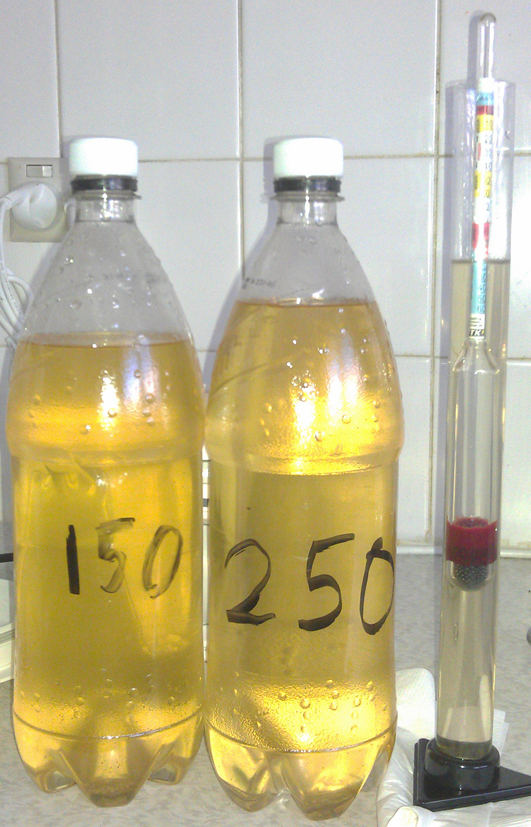
Apple Cider 1+2

Apple Cider #1 and #2 in bottles with gravity reading

Bottle 1.
1.2 liters of apple juice
150 grams of sugar.
1/8 th (ish) teaspoon of yeast.
1/4 th (ish) teaspoon of yeast nutrient.

Bottle 2.
1.2 liters of apple juice
250 grams of (caster) sugar.
1/8 th (ish) teaspoon of yeast.
1/4 th (ish) teaspoon of yeast nutrient.

Process is exceptionally easy. Put juice in blender. Add sugar. Blend. Pour into bottle. Add yeast (and nutrient). Put lid on. Shake. Done.

The yeast nutrient was probably not required. But after the low fermentation I’d a few beers at my place I didn’t want to take any risks.

A you can see the only difference is the amount of sugar. I deliberately wanted to see how the difference in sugar levels would work. Of course the gravity readings were going to be high. I sort of expected something like the 1.089 original gravity for bottle 1. But was still a little shocked when it came in as 1.111 for bottle 2.

The idea is to only let it ferment for a week. Then they will go in the fridge for a week to settle out. In theory this should prevent full fermentation. That means it should still be sweet and should not be too high in alcohol. Will wait and see.

-Mikey

Tagged , , , , ,

“The Beagle” Double IPA – Review

As Chas mentioned a few days ago, on the weekend we did a brew of an IPA. Chas will be posting the write up on that sometime soon.

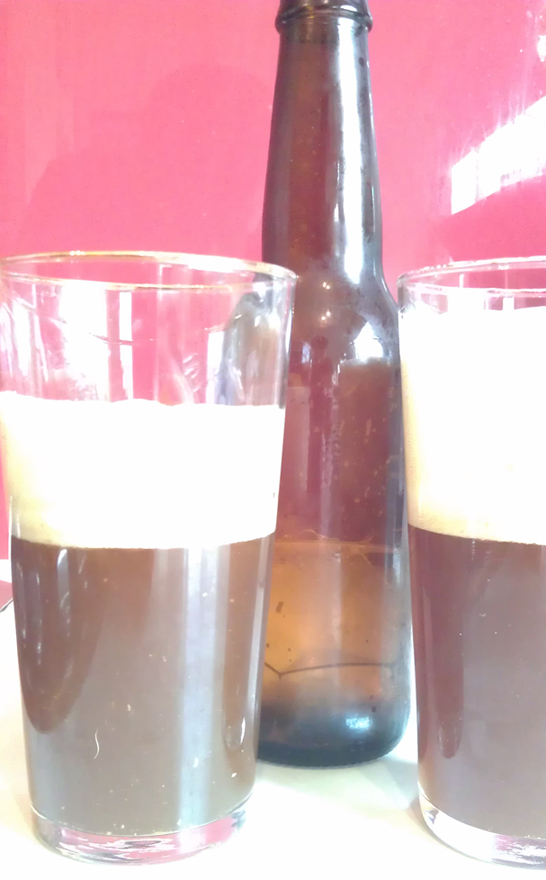
The Beagle

The Beagle, double IPA in glasses

As part of any good brew day there are tastings of recent brews. One of those was the previous IPA, and a double IPA, The Beagle.

This is a very big IPA, which is what you would expect from a double. There’s plenty of hops across the board. Big round orange fruit aroma from the Amarillo hops.

There’s a lasting and solid body as the back bone for this beer. The body is sort of a sweet caramel amber style. The bitterness is quite strong and full across the length of the beer. Initial hops are large and quite a hit. After a couple mouthfuls you get use to it and the tasty hop flavours come out quite a bit.

About mid way into the beer the bitterness really kicks up a notch. And overall the bitterness is almost too much. The strong sweetness balances it a bit and saves this from being too crazy to enjoy. With a couple minor tweaks this could become an amazing beer.

Really good beer over all. It does demands your attention and you can’t try to do much else, not that it’s a bad thing. Sit down, shut up and enjoy.

Food? Nah, don’t bother trying to match anything with this. Okay, if I was pushed to find something then I might suggest something strong and salty like BBQ pork.

-Mikey

Tagged , , , , , ,

“Gauss’ Law” Hopped Cider – Review

Quick note that there’s no brewing this weekend. Chas is overseas and I’ve already got a brew in the shed.

Last weekend we tried a few different brews. Chas has already put up his review of the stout. The review of the Australian Pale Ale will go up in a couple days.

Another one we tried was “Gauss’ Law” Hopped Cider. Another experimental cider from Chas. As was pointed out to us, a malted cider is called a Graff. Not sure what a hopped cider (with no malt) would be called. Anyway, we got around to share a bottle. And at over 10% alcohol I’m glad we didn’t have one each.

First up there was plenty of earthy apple aroma. Rich and woody without a strong sweetness. Good on the nose and matches well with the flavours.

Wow, this is complex and tasty. Initially it’s light and easy with the apple coming in quite subtlety then building big. It’s not until mid-late into it before the hops kicks in. There’s a good citrus hop flavour that sticks around for a long time. The bitterness keeps the apple in check and there’s no sickly sweetness anywhere in sight. If anything there’s a bit too much hops here. Bitterness does get a bit much after half a glass. But, that may be a good thing given the alcohol level in this.

Food wise this would match really well with duck, turkey or chicken. Preferably roasted. Would also work with pork.

If Chas makes more of this I’ll definitely be getting my hands on a couple bottles for myself.


-Mikey

Tagged , , , , ,

Lesson learnt, a bit too late

On Sunday we had another brew day at my place. Was time to do another Porter and a using some grain for the first time since the Brewsmith kits.

There was bottling of the Australian Amber Ale and tasting of the Australian Pale Ale. Both are a lot darker than ‘amber’ or ‘pale’ and should be renamed ‘dark’ and ‘amber’. The tasting of the Amber was, how should I put this, bad. The idea behind the two brews really wasn’t thought out well enough. I had assumed the sugars in the liquid malt cans would mostly ferment leaving only a slight sweetness. I was very wrong. And I should have realised it when we did the gravity readings. Chas has a review that will be going up, but to summarise… it’s bad. The amber came in at lower gravity than the pale, so that might be worse. I’m not going to even attempt tasting the Amber Ale in two weeks. I think both beers need to condition for a number of months, maybe six or more.

So, with that in mind I’m very glad we did a brew of something that should turn out a fair bit better. Or at least in theory. The brew can’t be classified as a ‘Partial’ because the grains used were crystal. That means no enzymes to convert starch into sugar, aka a mash. This was Steeping of the grains, and therefore this brew should be classified as an extract. Plus a can of amber liquid malt extract was used. There was 500 grams of Crystal (ebc 115-145) used.

Baltic Porter #1

Grains for Baltic Porter #1 steeping in the pot

I wanted to get the most out of the grains so steeping occurred for a full 60 mins at around 80C. I say around 80C as the temperature wasn’t fully controlled the whole time. It dropped down to around 77C and was as high as 86C at one point. Not great. But, in defence it was only steeping and not mashing.

And so the Baltic Porter started.

After steeping there was a sixty minute boil. The can of liquid malt and the liquid from steeped grains were all thrown into the wort. Once the hot break occurred in went 7 grams of Warrior hops.

After 30 mins there were 3 grams of Fuggles added. Then finally another 2 grams five mins before flame out. This was then put in the big 30L fermenter and topped up to the 10L mark. Windsor hops were added and fermenter given a good shake to get more oxygen due to the expected high alcohol.

  • Crystal grain (ebc 115-145) – 500g
  • Black Rock Amber liquid malt extract – 1.7k (cans are now bigger)
  • Warrior Hops – 7g
  • Fuggles – 5g (split 3-2)
  • Danstar Windsor yeast – aprox 5g

The original gravity was calculated at 1.081, but only came in at 1.072. That’s probably a good thing considering what happen to the two Australian Ales recently brewed.

The day had some painful lessons. And they were kept to small batches so there’s not too much pain. If this Baltic Porter turns out bad I think it might be time to return to some kits for a little bit.

-Mikey

PS. Forgot to mention we tasted the Black Rock Miners Stout and Gauss’ Law hopped cider. Review for stout is up and review of Gauss’ Law will be coming soon.

Tagged , , , , , , , , , , , , ,

Same-same, but different

Brewing day. Ah, nice to have one that doesn’t involve having to fill 80+ bottles. Due to craziness, ie doing other stuff, brew day was moved to Saturday. Plus there was no need to do a supply run which always saves a fair bit of time.

Australian Pale Ale #1

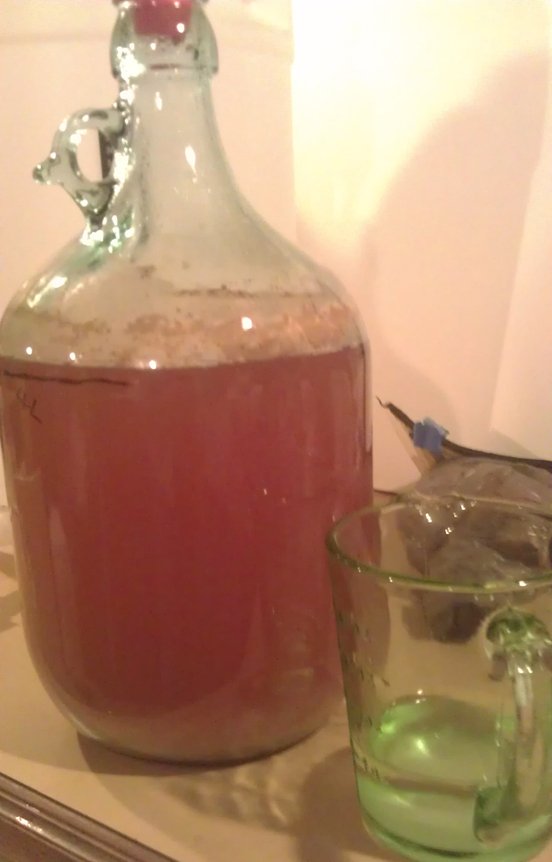
Australian Pale Ale #1 in carboy with separation after 2 weeks.

In the last brew we made the Australian Pale Ale #1. This was an experiment to see what could be done with just a can of liquid malt and hops. It was an attempt to make a very simple but still tasty home brew beer. Last time it was a can of light malt, this time amber malt. Rest of the recipe was the same. Same hops, same boil time, same yeast. Well, the yeast was slight different combination and I’ll explain a bit further down.

So, bottling the Australian Pale Ale #1 was quick. Only 12 bottles used, and the last one wasn’t a full one. There was a huge amount of sediment on the bottom and the brew looked like it had separated at the half way point. Not sure what that was about. There’s the pic to the side here. Anyway, we did a quick stir to mix the two half’s together before bottling. Due to the massive amount of yeast the bottles were very cloudy. I’m not sure how much sugar wasn’t fermented and this is the first time I’m a bit concerned about exploding bottles. Very interesting that the final gravity reading came in at 1.040. That’s high, very high. I’m thinking it’s mainly to do with the huge amounts of yeast. Anyway it means the beer will be 8.6% after bottled. Yay, finally a strong beer.

After that was all done it was onto making the Australian Amber Ale #1. Yes, I know the names are basic and Chas comes up with some great ones. I just can’t be bothered until I get one that I’m happy to continually remake. Plus, the name says what it is.

Started with three litre boil and threw in the can of liquid amber malt. Start of boil added 3 grams of Warrior hops. Twenty mins latter added 2 grams of Galaxy hops. Then 15 mins later another 2 grams of Galaxy hops. Five more mins then flame out and into the sink for a cool bath. Once temperature was close to what was needed it was pored into the carboy and topped up with cold water. Chas got shaking with the carboy and gravity readying was done, 1.097. That’s less then the Australian Pale Ale #1 and I think it’s because a bit more water went into this at the end.

Australian Amber Ale #1

Australian Amber Ale #1 in carboy.

Yeast for the last beer was an issue. There was too much left and the SN9 wine yeast was only put in after 10 days which didn’t do much. So, for the Australian Amber Ale #1 there was a change in what was done. Only half of a kit yeast pack was put in, and the SN9 wine yeast was put in at the same time.

  • Black Rock Amber Liquid Malt Extract – 1.5kg
  • Warrior hops – 3g
  • Galaxy – 4g (split)
  • Kit ‘Premium Brewing Yeast’ – 2.5g
  • ‘Premium Wine Yeast’ SN9 – 1g-ish

A good brew day was had. We busted out the Newcastle Brown and had a couple. Chas put up the review yesterday. Had a couple of the lagers, but one bottle was flat (no sugars in the bottle?). And opened a stout, but it’s not ready yet.

-Mikey

Tagged , , , , , , , , , , , , , ,

The Friedlieb coffee porter – review

Was meant to put this up a week ago. Then things happened. And now it’s this week.

The Friedlieb coffee porter

The Friedlieb coffee porter in glasses

As part of the massive bottling day, I mean brew day, there were some taste testing.

One was the coffee porter from a few weeks ago. We cracked one open, not smashed it open. Up front there was plenty of malt and coffee aromas. You could tell straight away this was going to be a big and complex beer.

First taste got a big malt hit. Rich flavour all the way through giving this beer a strong base. The coffee was also there for the whole journey, not overpowering or overpowered. Has a nice dry finish thanks to the coffee. Good bitterness from start to end but is a little all over the shop.

Some smoke and even hints of chocolate. Chas wants more smoke and I’m sure he’ll talk about that in the comments below. For me, I was happy with the malt profiles and mix in this.

The beer had a slight sweetness hidden in it. Like the bitterness, it wasn’t consistent. Unlike the bitterness, that was distracting. This would probably settle after another two plus weeks of conditioning.

Like the other other coffee porter, OMG The Coffee, this is suited to a lot of foods. Any big rich dinner would work. A lot of desserts would go well. You can substitute this for wherever you need a big dark earthy red wine.

-Mikey

Tagged , , , ,

The Beagle Double IPA – First Trial

For those familiar with the story of the IPA beer style, you’d know it’s characterised by being higher in the hops and alcohol.  This trend started when the British colonised India and were unable to transport their beloved pale ale from England to India without it spoiling.  Fortunately, hops and alcohol act as a natural preservative: so increase these two important beer ingredients, and your beer can go anywhere!

A double IPA, or an Imperial India Pale Ale, is generally even higher in hoppyness and alcohol than a standard IPA.  This should last even the longest sea journeys…

So, in honour of one of the great scientific sea journeys of all time and the boat, the HMS Beagle, today we made The Beagle Double IPA.

And before I go into the recipe, hopefully readers will have noticed the general theme going on in my beer names.  At the risk of starting a flame war with Mikey, at least my names are better than Mikey’s “Australian Pale Ale”.  Take that Mikey.

The trend of naming my beers after famous science figures is thanks to the proprietor of my favourite cafe, Husband.  So I’ll give credit where credit’s due.

Anyway, the recipe!

A friend of mine, Matt, had had some success with a simple mini-mash (edit, this is not actually a mini-mash recipe.  I’ll go into it another time.  i have a bad habbit of just saying “mash” if i use grains.  cheers Stu for keeping me honest) IPA recipe that called for a small grain bill of crystal, some dry malt extract, and two types of hops for bittering and aroma, but no dry hopping…  I need to have a chat to Matt about this as well, because the recipe called for a total of 50 grams of hops for a four litre batch.  Now I like hops as much as the next guy, but this would have just been nuts…  Mikey and I modified the recipe to our taste and sanity levels accordingly:

  • 75 grams crystal
  • 25 grams dark crystal
  • 30 grams rye
  • 1 kilogram golden light dry malt extract
  • 15 grams Citra – bittering hops; 60 minutes total boil
  • 10 grams Willamette – taste hops; 30 minutes total boil
  • 15 grams Amarillo – aroma hops; five mintues total boil
  • 10 grams Citra – dry hops; after two days
  • Safale yeast US05

Steep the grains in 1.5 litres of water in a grain bag for a total of one hour, keeping the temperature between about 70 and 80
It begins!

It begins!

degrees C.  This needs to go in at about thirty minutes into the boil, so start this first.  Personally, I prefer a grain bag but they’re not mandatory, it just makes things a little easier.

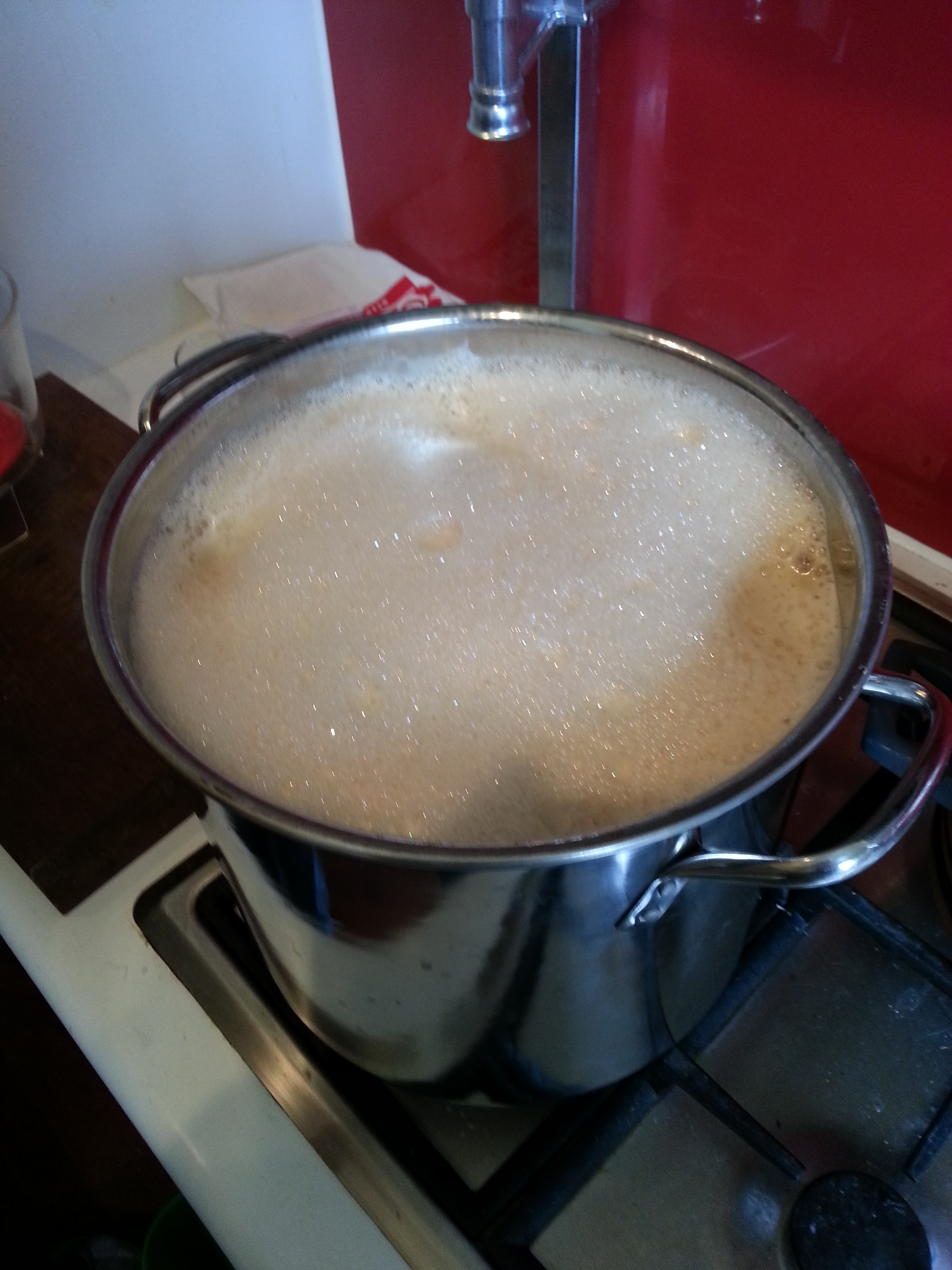
While the grain does its thing, boil 2.5 litres of water with the kilogram of malt extract.  We got a huge hot break, but that was mostly Mikey’s fault for purposefully making bubbles when stirring in the malt.  I’m glad we used the big pot.

At the hot break, throw the Citra in for a total of 60 minutes.

After thirty minutes, put in the Willamette and the water from the steeped grain.  Sparge the grain with about 0.5-1 litre of boiling water to make sure you get all the goodness.

Thanks Mikey...

Thanks Mikey…

Finally, with five minutes left in the boil, throw in the Amarillo.

Put the pot in a sink of cold water or use a wort chiller to get it to temperature, throw it all into a 5 litre carboy and top everything up to 4 litres in total.  Pitch the yeast and you’re done!

Don’t forget, after two days, add the second batch of Citra for dry hopping!

Other Brewing Notes:

We got a final gravity of 1.076, which I was pretty happy about.  With any luck, this should give an alcohol content of at least 7.5% ABV.  Because of this (and the general hoppyness), this is starting to get into the Double IPA range, so that’s what we’re calling it.

In regards to the hops, this recipe has three types of hops.

The Citra had a typical bittering hops smell: lots of bitter and spice aromas, with a bit of a tropical feel to it.  I find Citra a little more laid back than other bittering hops, but it’s definitively still there!  When this was first added to the wort, it didn’t do much to combat the malt smells, which were quite milky.

The Willamette was far more laid back than the Citra, a brief description of Willamette can be found in the Friedlieb Porter recipe.  Generally drier in smell.  With the Willamette, the malt smells were finally getting put in their place and the hops were finally starting to come through.  There was going to be a lot of spice in this beer.
20130728_143554Finally, the Amarillo had less bitter than anything else in there.  It’s a typical fruity hop for aroma.  The citrus really pushes through and there are a few earthy smells to it as well.  With the addition of the Amarillo, the malt finally lost the battle and the true IPA scent filled the kitchen.  Everything was much more balanced.

The wort tasted great, albeit, very sweet thanks to the very high gravity.  Of course the hops hadn’t had time to settle, so rather than get multiple notes, all there was was one big blast of bitter and spice – it hit and it hit hard.  I’d like to keep some of that for the final beer, but a little more subtle!  We’ll see what happens.

Anyway, great brew day.  Afterwards we went out for Mexican.  So for those wanting to re-produce this recipe exactly, go out for Mexican afterwards to ensure the same results.

-Chas
Tagged , , , , , , , , , ,