Category Archives: Experiments

Bottle day now with 20% more bottles, and a brew

Sunday was another brew day, of sorts. Really it was more of a bottling day with a brew at the end.
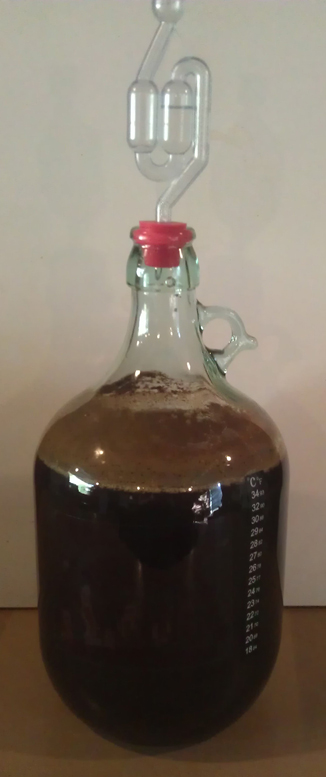
Australian Pale Ale 1

Australian Pale Ale 1 in the carboy

First order of business was to pick up some new supplies and equipment. My hydrometer broke last brew day and needed another. Needed some more no-rinse sanitizer. Plus picked up some liquid malt, hops (Warrior & Galaxy) and carbonation drops. Decided to go for more carbonation drops as I didn’t want to prime by measuring sugar, and was too lazy to work out how to do bulk priming.

Once back, it was onwards to the bottling. First up was the last 5 odd litres of the Newcastle brown. That was okay. Got 15 bottles in.

Next was the Stout. Gravity reading came in at 1.020 which means after bottling it will only be 4.0% ABV. That’s pretty low for a Stout. Might even need to call it a dark porter. Anyway, we needed to bottle all of it. ALL 23 litres! That’s 68 stubbies! Needless to say, this took most of the day.

Had a couple of breaks along the way. Got to try Chas’s coffee porter. Cracked open a bottle off the Newcastle brown, but it wasn’t ready yet.

Finally after bottling was done we moved onto brewing. For the past couple if weeks I’ve been thinking about how to get a very strong beer and still keep it easy. There’s a couple ways you can go about doing that, and hopefully over the next few months we’ll try as many of those options as we can. To make sure nothing too crazy is done I’m using a home brewing spreadsheet that let’s you put in ingredients and it tells you what characteristics of the beer will be. It’s amazing and I highly recommend getting your hands on it. You will need to sign up to Aussie Home Brewer if you haven’t already.

Anyway, this time around the brew was going to be a 4.5 litres batch for the carboy. Was using liquid malt extract that hadn’t been hopped and doing a 40 min boil with three hop additions.There was a whole 1.5kg can of liquid malt that went in. For a brew this small that’s right on the edge of madness, but I was keen to do this as a real test if a few things.

For lack of a better name, this is getting called Australian Pale Ale #1.

A big pot was filled with 3 litres of water, set to heat and LME was added. After the hot break added 3g of the Warrior hops. Twenty mins later added 2g of Galaxy hops, then last 2g of Galaxy was added 5 mins to the end. When the liquid malt went in the can was washed out with some boiled water. Not sure how much, but originally I was concerned we had to much liquid. In the end a lot boiled off leaving something just over four litres left. Given there was so much heat it took quite some time for the wort to cool down. The pot went through two long cold baths to get down to 22C. As there was a lot more liquid boiled off, I needed to top up the carboy with some extra water. Then I took a sample for a gravity reading.

Yeast was pitched. Used a whole pack of kit yeast as I had some spare lying around. Then give the whole thing a good shake, BrewSmith style.

Then, I checked my gravity reading and it was much lower than expected. Ahhh! I didn’t mix my wort properly. So, get rid of the sample and took another, which took out some of the yeast. But, that’s okay ‘cos there was a huge amount of yeast. Anyway the gravity came in a whopping 1.102!!

  • Black Light Liquid Malt Extract – 1.5kg
  • Warrior hops – 3g
  • Galaxy – 4g (split)
  • Kit ‘Premium Brewing Yeast’ – 5g

So, a few days in and the brew its going well. Huge amount of activity, but no blow out (lucky). From what’s coming out of the airlock, it smells great. Thanks to Chas in about 4-5 days I’m going to throw in some SN9 ‘Premium Wine Yeast’. This will eat up the last of the sugars, and have something to carbonate the bottles.

-Mikey

Tagged , , , , , , , , , , , , , , ,

Malted Cider – Review

Malted Cider

Malted Cider in glasses

A while ago Chas ordered some malt for a brew and it exploded in the mail. A replacement of malt was sent, and about half of the original malt was still left. What a great opportunity to add malt to something, like a cider.

I’m no fan of ciders. I’ve made that view quite clear. But the rhubarb and apple cider Chas made was nice and enjoyable. So, I went into this with an open mind.

The first thing I noticed with the cider was an unpleasant off egg smell. Chas ensures me that the other bottles are fine and don’t have any eggyness.

The flavour was okay. Apple sweetness right up front, then a slight sour taste. After that the malt comes through a bit. There’s a bit of egg taste at the end which isn’t nice. The body holds well and if it wasn’t for the egg I might enjoy this.

Not sure what food to match this with. The dud bottle makes it harder. I’m thinking Italian, maybe a spicy and/or greasy pizza. Might work with a red meat Mexican dish like tacos or burritos.

I would like to have another one of these ciders. I think this could be tweaked to make it quite nice. As long as the bottle is good.

-Mikey

Tagged , , , , , , ,

Chocolate Paradise Porter (with coffee) – Review

A little while ago, we modified the standard BrewSmith Chocolate Paradise Porter to contain coffee.  For those interested, the original Chocoalte Paradise Porter brew is here, while the review is here.

Overall, the beer turned out great.  We only made twelve bottles, and by the time tasting day came around, there were only three bottles left because Mikey’s wife (AKA Manager for Change Management/Director of Art Direction for this blog) had made her way through the rest of it!  I think she enjoyed it…

Anyway, the original taste prior to bottling was encouraging, although there was a lot of coffee in there, and it was slightly overwhelming.  After the beer was allowed to condition for a few weeks in the bottle, the overpowering flavours calmed down quite a bit.

20130707_153019The coffee was still quite obvious at first, and it really sat in my mouth.  This died down after awhile though and I started to get used to it, which allowed the other flavours to come out.  As the coffee died down, the brown sugar (which was another addition to the recipe) began to come out, but only slightly.  The brown sugar was more of a tease than an actual taste: it never came to the front.

The smoke, which was apparent in the original recipe, added a great twist as well.  It really began to compete with the coffee and add some a great interaction of different flavours.

Unfortunately, all of this tended to mask the chocolate somewhat.  The chocolate was still, but hard to find, and didn’t come out until the beer was allowed to breath for a bit.

In regards to smell, the beer was nowhere near as fragrant as it was with the original recipe.  As I mentioned, the taste before bottling had quite a bit of coffee to it, but the strong coffee smell went away with conditioning; I was really hoping for lots of coffee and peat to it, but it wasn’t there unless you really went looking for it.  There was also a little bit of spice and brown sugar in there to.  Although very subdued, the beer smelled fantastic.  I would have liked the nose to be bigger though.

All in all, this beer was full of great things, and they all complimented each other well.  It was great that there were different layers of flavour, some very obvious, some very subtle.  Sometimes the taste of something would come out of nowhere, and then wouldn’t return on the next sip.  It was a great and surprising beer.

Finally, it was great to see how a few very simple modifications could dramatically change a beer.  The original was good, the modification was better.


-Chas

Tagged , , , , , , , ,

Gauss’ Law – Hopped Cider

As mentioned, I made some cider this weekend!  Mikey doesn’t believe in cider so I had the aid of my friend who shall be referred to as the Cider Minion.  Although I’ve done brews on my own before, having a second pair of hands is always helpful, and Cider Minion was no exception.

I had originally wanted to do a proper batch of the Apple and Rhubarb Cider I made awhile ago.  The original brew was a bit haphazard so I didn’t do a recipe write up of it.  Unfortunately I couldn’t find any rhubarb, but I did have some left over hops from a porter we made, so I decided to make a hopped cider.

Judging from the Apple and Rhubarb Cider, this stuff was going to be strong; I was aiming for at least 10% alcohol.  I wanted to make this cider stronger than the previous version because I thought a little alcohol burn would add to the taste and feel of the beverage.  So I’ve decided to call this cider Gauss’ Law based on a really bad pun that I’m not going to go into.  Puns are awesome by the way.

Ingredients

  • 7 kg of Golden Delicious Apples
  • 1 cup dextrose
  • 4 grams Fuggles hops (bittering)
  • 2 grams Fuggles hops (aroma)
  • SN9 wine yeast

This was for a (what was supposed to be) a four litre batch.

Bring half a litre of water up to a boil and start steeping the bittering hops for 30 minutes.  At the 25 minute mark, add the aroma hops.

My juicer isn’t the most efficient machine in the world, so a better juicer or an apple press would probably require fewer apples, but I managed to get 3.5 litres of apple juice out of the apples, which is what I was after.  This 3.5 litres needs to be added to a separate pot from the hops and brought to a boil for about 15 minutes.  This will kill any bugs in the juice.

Once the hops are done, strain them into the juice.  Also add the dextrose (this can really be done at any time).

I was surprised this time around.  Previously I’ve gotten a pretty decent hot break out of boiling apple juice.  This wasn’t the case, even though I’ve used Golden Delicious apples before.  Oh well…

Once your juice has boiled for at least 15 minutes, put a lid on the pot and let it sit in a sink full of cold water for at least 20 minutes, changing the water regularly.

Throw all of this into a 5 litre fermenter and pitch the yeast and it’s done!

Unfortunately this process only left me with about 3.5 litres all up, even though I started with half a litre of water for steeping the hops and 3.5 litres of apple juice.  I guess I underestimated how much I would lose to evaporation in the boil, or I under measured things.

The OSG I got was right on 1.070, which wasn’t quite as high as I was hoping for.  The OSG on the Apple and Rhubard Cider (which didn’t have added dextrose) was 1.064, I was probably a little conservative with the dextrose.  The previous cider managed to get a FSG below 1, but I don’t quite expect that with this one because the hops are adding to the specific gravity (although only slightly).  My prediction is an alcohol content of about 9.5% after bottling.  It’s not quite what I wanted.

Anyway, that’s going to take at least two weeks in the carboy, then bottling, then tasting.  We’ll see how it turns out!

-Chas

Tagged , , , , , , , , ,

“The Friedlieb” Coffee Porter – first trial

Friedlieb Runge was a German chemist and the first person to isolate caffeine. Because of this, it’s only appropriate to name our ongoing coffee porter experiment after him!

As much as we liked the Brewsmith porter kits we did (we’re still waiting to see how the coffee version turned out), they’re only sold with enough ingredients to make about four litres – so what do we do when we want to make a big batch? Adding to that, they are a bit expensive when compared to sourcing the ingredients directly. Don’t get me wrong on this. The price of the Brewsmith kits is quite fair, but if you’re willing to take the time to try and recreate their recipes, you can save a bit of money. If you’re not willing to take the time to recreate the recipe, then hey, keep buying the kits because they do a great job.

Anyway, as a base, we used a recipe presented by the great Craig of Craigtube. If you haven’t checked this guy out yet, do it! We weren’t able to get all the ingredients here in Australia, plus we didn’t want to use a canned wort with bittering hops in it, so there was some improvising.

20130609_182318

Since this was the first attempt, it was only a 4 litre batch.

The recipe and ingredients we went with was as follows:

  • 580 grams light liquid malt extract
  • 90 grams dark dry malt extract
  • 90 grams dark crystal
  • 50 grams chocolate malt
  • 40 grams peated malt
  • 50 grams melanoidin malt
  • 60 grams rye malt
  • 3 grams Willamette hops (bittering)
  • 3 grams Fuggles hops (taste)
  • 3 grams Fuggles hops (aroma)
  • 8 shots expresso
  • 1 cup brown sugar
  • Windsor style ale yeast

Steep the grains (using a grain bag) in about two litres of water for 20 minutes (on reflection we probably should have done 40…). When this is done, remove the grains and sparge them with a litre of boiling water.

Bring this three litres up to a boil and throw in three grams of Willamette hops for the start of your thirty minute total boiling period. At the 15 minute mark, put in three grams of Fuggles hops. Finally, with five minutes remaining, put in another three grams of Fuggles.

At the end of the thirty minute boil, turn off the heat and put in the eight shots of espresso as well as the brown sugar and give it a good stir. Put a lid on the pot and immerse it in a sink of cold water for twenty minutes, changing the water halfway through.

Throw this all into a five litre carboy, and top up with one litre of water. Try to get the temperature to between about 18 and 26 degrees with this top up.

Pitch the yeast and you’re done!

Other Notes

We got a gravity reading of 1.054, so we’re expecting an alcohol content of somewhere in the mid 4% range after bottle conditioning; I imagine the final gravity will be a little high due to the yeast type as well as the coffee, which isn’t fermentable but adding to the specific gravity.

In relation to hops, I found that the Willamette had bitter and dry smell with a hint of spice. The Fuggles were less bitter, with a more fragrant fruity/floral smell.

While the wort was boiling, the chocolate was quite overpowering when right over the stove, the smokiness came out quite a bit when I stood back. There weren’t any big hops smells, but when tasting the wort, they were definitely there and quite nice.

Overall, this should be a pretty good brew. We’ll see if it’s anything at all like the Brewsmith kit, but it should taste good any how.

-Chas

Tagged , , , , , , , , , ,

Apple and Rhubarb sour cider – Review

Apple and Rhubarb sour Cider

Apple and Rhubarb sour Cider in glasses

As you have read already, Chas is making cider. My views on this are pretty clear. Cider is not beer and therefore not as good. I’m prepared to change that view if there are ciders that can show their complexity and range.

This might just be the first cider to do that.

First, it’s not sickly sweet, or driven by sweetness, like a lot of commercial ciders.
Second, it’s for more than just one flavour. The majority of commercial ciders are apple flavour. There’s more range now but still it’s one flavour: pear, raspberry, strawberry, and any other berry you can think of.

Third, commercial cider has to be served very cold for it to be drinkable, but this one… no wait, it still needs that.

There is a lot of sourness here. And I do mean a lot. There’s just enough sweetness to prevent this becoming undrinkable. Keeping this cold helps a huge amount.

A quick note on the gravity. Original was 1.058, final was 0.994. That gives it an alcohol content of 8.9%. As a result there is a big body here that helps hold it all together and drives the big flavour.

My criticism is that:

  1. It’s not a beer.
  2. The sourness becomes a bit too much by the end of a glass.
  3. The alcohol level stops it from being a session drink.
  4. The flavours could be slightly better balanced.

Overall I’m pretty happy to drink this non-beer.

-Mikey

Tagged , , , , ,

Malted cider or un-hopped apple ale?

Hi everyone,

So as I mentioned in my last few posts, I have a juicer, and I have a bit of extra malt.  So why not try throwing some malt into some apple juice and see what happens?

20130518_145533I went down to my local market and found a pretty good deal on organic juicing apples, i.e. apples that aren’t pretty enough to sell as eating apples.  I bought a hell of a lot – about 7 kilograms!

I had read in various places that you get about 1 litre of juice from 1-2 kilograms of apples, so I thought that this would be enough for about 4 or 5 litres of juice.  Unfortunately I was pretty wrong and only got about 2 litres.  I’ve since found out that this ratio works better for apple pressing, which is a much more efficient method of extracting juice.  Using a juicer like I have tends to lose a lot of juice to the pulp it creates.

I’m not going to go out and buy a juice press, but next time I may try squeezing out the pulp.  We’ll see.

Anyway, after cutting up a whole bunch of apples and juicing them, I wasn’t left with the amount of juice I thought I’d get.  So from there, things began to turn into an un-hopped apple beer rather than a malted cider.

I set my 2 litres of juice to boil and added a cup of golden light liquid malt extract.  The hot break was huge on this one; the pot was only about a third full, and it still nearly boiled over!  Once that was under control, I let it boil for 15 minutes while I did some cleaning.

After the boil, I let the bottle sit in a sink full of ice water for 10 minutes, emptied the sink, and then filled it up again for another 10 minute bath.

Once this wort was in the carboy, I topped it up with about 2 litres of water – so this batch is going to be 4 litres in total.

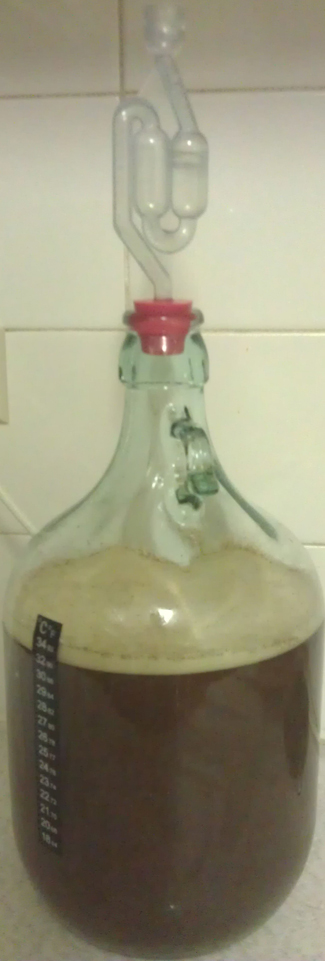
Two litres juice, one cup malt, two litres water

Two litres juice, one cup malt, two litres water

The yeast i used was an SN9 wine yeast.  It’s what I had on hand, but, considering there’s malt in there, I probably should have gone and used an ale yeast. That’s something to experiment with later.

The wort was tasty.  It wasn’t overwhelmingly apple-y or beer-y, but had good hints of each.  So I’m confident I’ll get something interesting out this.

The OSG was 1.028, which is a little lower than I would have liked.  As a lot of that sugar is fructose, I should be able to get a final gravity pretty close to 1, so that’s promising.  Alcohol content should be around 4% after bottling.

I’d like to see if I can push the alcohol content a bit higher, so I might add some dextrose next time.  Of course the other option is adding more malt or juice, but, assuming the mixture of flavours is good, I don’t want to upset this balance.  Dextrose won’t alter the flavour.

Assuming this turns out tasty, I’ll also look at hopping it, which will make it a proper beer.

So we’ll give this a week and see what happens!

-Chas

Tagged , , , , , , , , ,

I like coffee and beer, lets do this!

Choc coffee porter

Choc coffee porter

Since the first brew I did back in January this year I’ve been thinking about changes to the recipes of the kits. The most appealing was to have a coffee porter. That dream has come true.

The base is the Brew Smith Chocolate Paradise Porter. But there is a fair amount of coffee in it. So, I’ve dubbed the beer “Chocolate Paradise OMG The Coffee!! Porter”.

We made this on Sunday 28 April. As a result I can’t remember exact details on where we did the following steps. Hopefully Chas can clear up a few points.

Even without changing the porter base, a change was made. For the grain pot we used a grain bag. This meant no grain all over the place when adding in or pouring into the carboy. Plus it meant we could squeeze the liquid out of the grain a lot better. And get more of the flavour into the beer.

While the wort was bubbling away, after the hot break, coffee was added. I used my 8 cup percolator to brew the coffee. Was a mix of coffee grains, so don’t ask what coffee. Given this is a small batch of beer, that’s a lot of coffee.

While wanting to make a coffee porter I also wanted to up the alcohol. So a full cup of soft brown sugar was also thrown into the mix. That was about 100 or 150 grams of sugar. Will confirm later.

So, added coffee and added sugar. Petty bold. Because we had the grain bag we might have not used the mesh sieve when pouring the wort into the carboy. That means we forgot to remove the hops. Hopeful Chas remembers if we did or not. If not, this might be a very hoppy, and cloudy, beer.

The brew sat fermenting for two weeks at about 22 degrees Celsius. That’s probably too warm for this type of ale. But I’m pretty sure the fermentation process was done.

Gravity reading was a high 1.080 for original and dropped to a final reading of 1.020 when bottled, on Saturday 11 May.

The sample we took at bottling was very rich in coffee flavour. Plus the typical dark sweetness of the brown sugar was there. This beer is going to get a minimum of four weeks conditioning, some maybe twice as long. That should allow the porter to really come back up while the coffee mellows out.

I’m hoping the brown sugar fully fermented in the carboy. I really don’t want any exploding bottles. Time will tell if this is a success or not.

So I bought a juicer…

So I bought a juicer by mistake.

As you may be aware, juicers make juice.  If one pours this juice into a container, pitches some yeast, and then seals it with an airlock, one has a lovely cider.  This is why I bought a juicer. According to the instructions, I also have the option of drinking the juice before I ferment it, but I don’t see a reason why I would do such a thing…

My new juicer!

My new juicer!

So this thing is hardly top of the line, but it will get the job done.  I’ve opted for the model that can fit a whole apple down the chute, just in case I want to do that.  I’ve done some research on juicing – maybe if I really get into this whole cider thing I’ll discuss juicing methods at length.

I’ve looked into cider making and the process is pretty simple:

  1. Get/make juice.  If you’re using store-bought juice, be sure there are no preservatives. Preservatives will mess with the final taste and may kill your yeast.
  2. Set juice on a low boil for about 15 minutes.
  3. Cover pot and cool the juice as quickly as possible.  This can be done by placing the pot in a sink full of cold water/ice.  Change the water out after 10 minutes.  Ultimately you want the temperature to be below 30 degrees C (slightly warmish).
  4. Put juice in carboy or fermenter.
  5. Pitch yeast.
  6. Place lid and airlock.
  7. Magical process!
  8. Bottle as per beer.
  9. Magical process!
  10. Cider!

The whole purpose of this cider endeavor is to just play around with different fruits and see what happens, so I’ll keep you updated.  I’ve already got a small batch of apple and rhubarb going in my new 5 litre carboy.  I’m not going to do a full report on this one though as it was all really haphazard. If it turns out remotely OK, I’ll do a proper batch of it and give the full recipe.

I have already learned a few things:

  • Apple or pear is probably your best base.  Start with this for the bulk of your cider and add other things to taste.  Just be careful of too much citrus, the acid may kill your yeast.
  • Your local brew shop will have good quality apple or pear juice in concentrate if you want it.
  • Similar to glucose, fructose, which is the main sugar in fruits, will ferment completely. If a sugar ferments completely, it won’t leave any sweetness or taste – it will all turn to alcohol.
  • Fructose will break down into other non fermentable sugars if you cut the apples up and leave them to sit for about 24 hours.  So if you want a dry cider, juice the apples immediately, if you want a sweet cider, cut them and let them sit.
  • Just the pure juice gives a pretty good OSG (I got about 1.045).  Feel free to add some glucose if you need some extra kick though, it shouldn’t alter the taste since it will ferment completely.
  • Use a good wine yeast.  Your brew store should be able to recommend something.  Just remember, don’t use a beer yeast.

I want to do some brewing this weekend.  If Mikey is available, we may do a lager similar to the big batch we did a few weeks ago, but tweaking the recipe slightly.  Alternatively, if I’m able to get enough apples, I might have a play.

Then again, I haven’t discussed the prospect of Random Cider with Mikey – he may love or hate this idea, but if he loves it, we may end up making cider together.

Regardless, I’m going to start experimenting with Random Cider as time goes by.

-Chas

Tagged , , , , ,